


Somewhere, in one small village, a handful of indomitable Gauls are still holding out... except most of us already surrendered. Most of us are already using AI at work, whether we like it or not. Sometimes it’s not even optional anymore, and I’m sorry to say, that’s probably not going to change.
Personally, I don't see that as only bad news. It speeds up the repetitive stuff so you can focus on what actually matters. But what about learning a language? I went and did some digging, and that’s what this episode is about.
This episode is free, and it’s the warm-up. The practical part happens live in L’Atelier on Wednesday 26 August at 7pm French time, reserved for premium members: the tools, the prompts, and yes, building your own French app without writing a single line of code.
Find the sign-up link in the subscriber chat:

Et maintenant, place au podcast — English translation available at the end of the article.
Une équipe du MIT a branché des électrodes sur le crâne de gens qui écrivaient avec ChatGPT. Et les résultats ne sont pas très rassurants.
Mais une méta-analyse de trente-et-une études sur l’apprentissage des langues dit exactement le contraire.
Et vous, vous utilisez déjà l’IA pour apprendre le français. Aujourd’hui. Sans le savoir.
Bienvenue dans cet épisode de French with Timo, où on ouvre le dossier qui divise tous les profs de langues : faut-il utiliser l’IA — l’intelligence artificielle — pour apprendre le français ?
D’abord, les mauvaises nouvelles
Le MIT a fait une expérience simple. Des électrodes sur la tête, et trois groupes qui écrivent un texte : un avec ChatGPT, un avec Google, un sans rien. Résultat, le groupe sans rien avait l’activité cérébrale la plus riche. Le groupe ChatGPT, la plus faible. Bon, jusque-là, ça n’étonne personne. Mais ensuite, cinq minutes après avoir écrit leur texte, beaucoup d’utilisateurs de ChatGPT étaient incapables d’en citer une phrase. Ils avaient écrit sans retenir. Les chercheurs appellent ça la « dette cognitive ».
Il y a aussi l’affaire Duolingo, que vous avez peut-être suivie. En 2025, l’entreprise annonce qu’elle devient « AI-first », l’IA remplace les concepteurs de cours humains. Sauf que les utilisateurs l’ont très mal pris. Certains suppriment volontairement des séries de cinq cents jours, par protestation. Et sur Reddit, un mot revient sans arrêt : « AI slop », de la bouillie. Franchement, en tant que prof, ça m’a un peu ému. Et le PDG a fait marche arrière quelques mois plus tard.
Et puis il y a un argument qu’on entend presque jamais dans ces débats, et qui est pourtant très concret : l’eau et l’électricité. Écrire un email de cent mots avec ChatGPT consomme environ un demi-litre d’eau, à peu près une petite bouteille. Et d’ici 2027, l’ensemble des infrastructures IA pourrait consommer l’équivalent de la moitié du prélèvement annuel d’eau du Royaume-Uni. Donc chaque fois qu’on demande à une IA de reformuler une phrase, il y a un coût quelque part, qu’on ne voit jamais depuis son téléphone.
Voilà pour le contre. Ce ne sont pas des arguments de vieux prof grincheux, hein, ce sont des données.
Maintenant, le positif
Première chose, et beaucoup ne la remarquent jamais : vous utilisez déjà l’IA pour votre français, sans le savoir. Le petit résumé qui apparaît en haut de vos recherches Google, c’est de l’IA. L’accent aigu que votre téléphone rajoute tout seul, c’est de l’IA aussi. Le train est parti depuis longtemps, et la question n’est plus « pour ou contre » mais « comment je monte dedans sans me faire écraser ».
Ensuite les chiffres, bah ils sont têtus. Une méta-analyse de trente-et-une études trouve un effet positif des chatbots sur l’apprentissage des langues. Une deuxième arrive à la même conclusion. Donc d’un côté le MIT nous dit attention danger, et de l’autre la recherche en didactique des langues dit que ça marche.
Et il y a surtout un résultat qui me parle beaucoup en tant que prof : l’IA réduit l’anxiété. Devant un robot, personne n’a peur du ridicule. Vous pouvez vous tromper trente fois de suite, il ne soupire jamais, il ne regarde pas sa montre. Et pour beaucoup d’entre vous, la peur de parler et de se ridiculiser est le vrai blocage, bien avant la grammaire.
Concrètement, qu’est-ce qu’on peut faire ?
Le plus simple, c’est de poser une question de grammaire précise, du genre pourquoi on dit « je me souviens de mon enfance » mais « je me rappelle mon enfance ». Avant, il fallait fouiller un forum. Maintenant, dix secondes suffisent.
Autre chose très intéressante : la conversation orale. En mode vocal, vous demandez à ChatGPT de jouer un rôle, un serveur, un vendeur, et vous parlez avec lui en temps réel. Vous pouvez lui demander de ralentir, de rester en B1, de vous reprendre à chaque erreur. Personnellement je l'utilise pour pratiquer mon anglais oral. J'ai même demandé à mon professeur du jour de simuler l'accent qui me pose le plus de problème en ce moment, celui d'une maman de Minneapolis avec qui je parle parfois quand j'accompagne ma fille à la piscine. Et au final on a parlé vingt minutes pendant que je cuisinais.
Ensuite il y a les exercices sur mesure. Vous confondez toujours l’imparfait et le passé composé ? Vous donnez dix de vos propres phrases fausses et vous demandez vingt exercices là-dessus, uniquement là-dessus, avec les corrections.
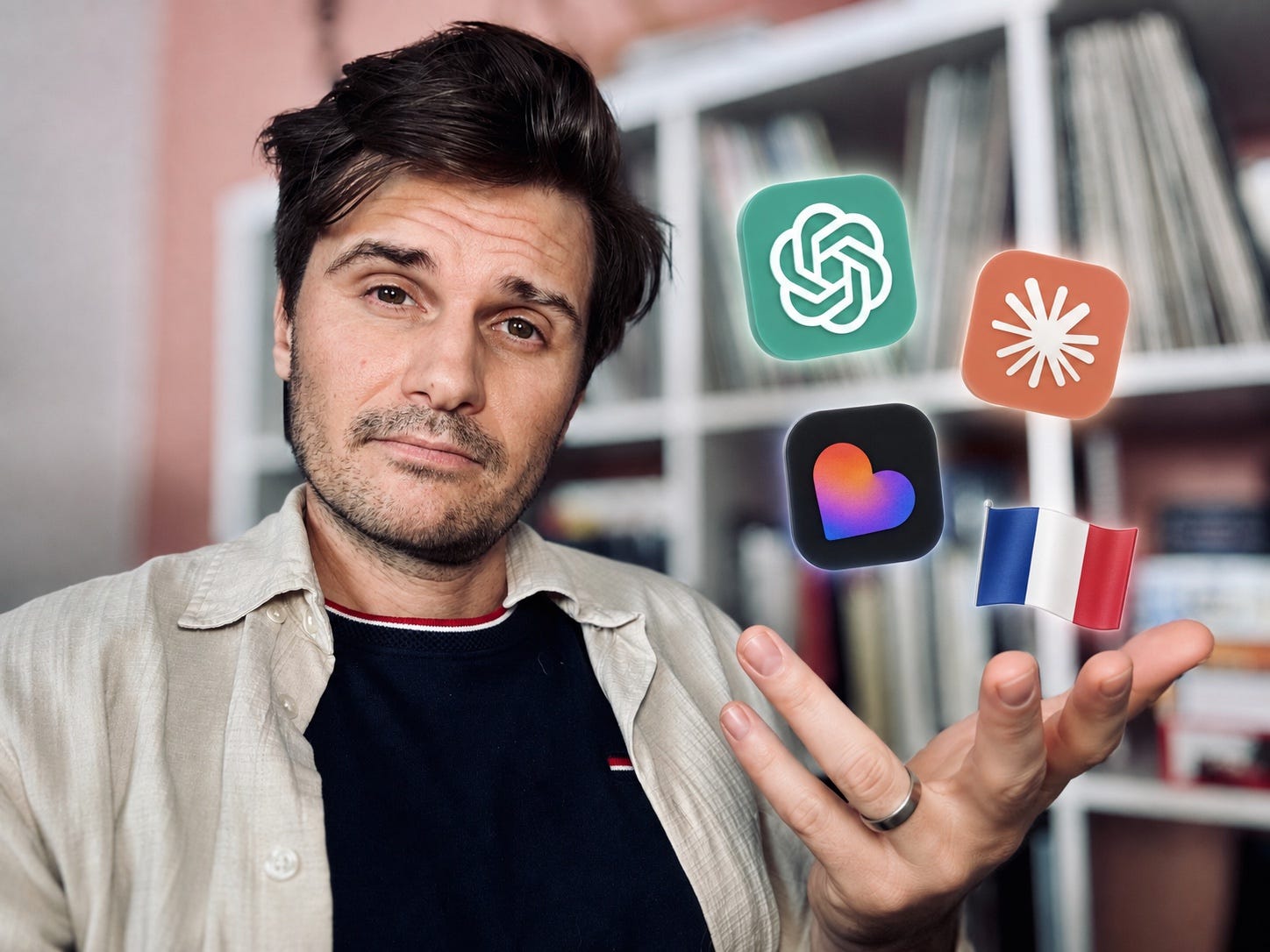
Et pour finir, le truc que je trouve complètement dingue : demander à une IA de vous construire une application. Avec un outil comme Lovable, une phrase suffit, du genre « crée-moi une appli qui m’affiche cinq mots de vocabulaire chaque matin », et l’appli existe, sans écrire une ligne de code.
Petite anecdote au passage : j’ai testé le mode vocal en français avec l’IA Claude. Il me répond avec un accent québécois, impossible de lui faire changer.
Mon verdict
L’étude du MIT ne dit pas que l’IA rend bête. Elle dit que si la machine fait le travail à votre place, votre cerveau se met en veille. Logique.
Mais apprendre une langue, ce n’est pas écrire un texte. C’est parler, se tromper, recommencer. Et pour ça, l’IA peut être un très bon outil, surtout pour les personnes qui manquent de confiance à l’oral.
Bon évidemment, ça ne remplecera jamais un prof de français, on est d’accord, et heureusement mais c’est un outil en plus.
Si vous voulez la partie pratique, c’est mercredi 26 août à 19h, heure française, pendant L’Atelier, le workshop réservé aux membres premium et il sera enregistré si vous ne pouvez pas être là. Retrouvez le lien d’inscription dans le chat des abonnés.
Retrouvez aussi la liste de vocabulaire ci-dessous et faites le quiz interactif pour pratiquer votre compréhension !
À bientôt et merci de m’avoir écouté !
Sources
MIT Media Lab — Kos’myna et al., Your Brain on ChatGPT: Accumulation of Cognitive Debt when Using an AI Assistant for Essay Writing Task (2025)
Lyu et al. — Effectiveness of Chatbots in Improving Language Learning: A Meta-Analysis of Comparative Studies, International Journal of Applied Linguistics (2025)
Wang, Cheung, Neitzel & Chai — Does Chatting with Chatbots Improve Language Learning Performance?, Review of Educational Research
AI-driven chatbots in second language education: A systematic review, ScienceDirect (2025)
Bastani et al. (2024), cité dans The Memory Paradox: Why Our Brains Need Knowledge in an Age of AI — sur les lycéens et GPT-4
Li, Ren et al. — Making AI Less Thirsty: Uncovering and Addressing the Secret Water Footprint of AI Models, Communications of the ACM (2025)
Jegham et al. — How Hungry is AI? Benchmarking Energy, Water, and Carbon Footprint of LLM Inference (2025) — comparaison énergie ChatGPT vs recherche Google
Kristen Doerer — Duolingo went ‘AI-first’ and then came the consumer backlash,
customerexperiencedive.com
Natalie Stechyson — Duolingo’s CEO says AI will soon replace teachers. But... should it?, CBC News
Liste de vocabulaire
La science et les études
le crâne : the skull
l’activité cérébrale : brain activity
une dette (cognitive) : a (cognitive) debt
têtu, -e (les chiffres sont têtus) : stubborn (the numbers don’t lie)
Le débat et l’opinion
grincheux, -euse : grumpy, cranky
faire marche arrière : to backtrack, to reverse course
Apprendre et se tromper
un blocage : a mental block
le ridicule (avoir peur du ridicule) : looking foolish (to fear looking foolish)
sur mesure : tailor-made, custom
fouiller : to dig around, to rummage
Expressions et images
de la bouillie : mush (here: low-quality content)
le train est parti : the train has left the station
se mettre en veille : to go into standby mode
dingue : crazy, insane (familier)
New: The interactive quiz is available directly in the app: frenchwithtimo.com

Bon week-end à tous, et rendez-vous le 26 août pour L’Atelier !
Timo

Hey, I’m Timothée.
I write about the French language the way it’s actually lived: through cafés, music, awkward conversations, old expressions, cultural rituals, and all the small things textbooks usually forget.
If you enjoy learning French through stories, culture, music, and the hidden meaning behind words, you’ll probably enjoy the premium version of this newsletter.
Become a premium member and get access to full podcasts, translations, vocabulary notes, interactive exercises, and live workshops — all for about the price of a coffee each month.
If you enjoyed this content but don’t feel like subscribing just yet, you can always buy me a coffee. It’ll motivate me to create more content like this!
English Translation
An MIT team put electrodes on the heads of people writing with ChatGPT. The results are not reassuring.
But a meta-analysis of thirty-one studies on language learning says exactly the opposite.
And you? You’re already using AI to learn French. Today. Without knowing it.
Welcome to this episode of French with Timo, where we open the file that divides every language teacher: should you use AI to learn French?
First, the bad news
MIT ran a simple experiment. Electrodes on the head, and three groups writing a text: one with ChatGPT, one with Google, one with nothing at all. The result: the group with nothing showed the richest brain activity. The ChatGPT group, the weakest. Fine, nothing surprising so far. But then, five minutes after writing their text, many ChatGPT users couldn’t quote a single sentence from it. They had written without retaining anything. Researchers call this “cognitive debt.”
There’s also the Duolingo affair, which you may have followed. In 2025, the company announced it was going “AI-first,” with AI replacing human course designers. Except users took it very badly. Some people deliberately deleted five-hundred-day streaks, in protest. On Reddit, one phrase kept coming back: “AI slop.” Honestly, as a teacher, that moved me a little. The CEO backtracked a few months later.
And then there’s an argument almost nobody brings up in these debates, and yet it’s a very concrete one: water and electricity. Writing a hundred-word email with ChatGPT uses about half a litre of water, roughly a bottle. And by 2027, AI infrastructure as a whole could consume the equivalent of half the United Kingdom’s annual water withdrawal. So every time you ask an AI to rephrase a sentence, there’s a cost somewhere, one you never see from your phone.
So much for the case against. These aren’t the arguments of a grumpy old teacher, they’re data.
Now, the positive side
First thing, and many people never notice it: you’re already using AI for your French, without knowing it. The little summary that appears at the top of your Google searches, that’s AI. The accent aigu your phone adds on its own, that’s AI too. The train left the station a long time ago, and the question is no longer “for or against” but “how do I get on board without getting run over.”
Then the numbers, and they’re stubborn. A meta-analysis of thirty-one studies finds a positive effect of chatbots on language learning. A second one reaches the same conclusion. So on one side MIT is telling us watch out, danger, and on the other, research in language teaching says it works.
Above all, there’s one result that speaks to me a lot as a teacher: AI reduces anxiety. In front of a robot, nobody is afraid of looking foolish. You can get it wrong thirty times in a row, it never sighs, it never checks the time. And for many of you, the fear of speaking and of making a fool of yourself is the real block, long before grammar.
So what can you actually do?
The simplest thing is to ask a precise grammar question, something like why “je me souviens de mon enfance” but “je me rappelle mon enfance.” Before, you had to dig through a forum. Now, ten seconds is enough.
After that it gets interesting: speaking practice. In voice mode, you ask ChatGPT to play a role, a waiter, a shopkeeper, and you talk with it in real time. You can ask it to slow down, stay at B1 level, correct you on every mistake. I personally use it to practise my spoken English. I even asked my “teacher of the day” to mimic the accent that gives me the most trouble right now, a mom from Minneapolis I sometimes talk to when I drop my daughter off at the pool. In the end we talked for twenty minutes while I was cooking.
Then there are custom exercises. Always mixing up the imparfait and the passé composé? Give it ten of your own wrong sentences and ask for twenty exercises on exactly that, and nothing else, with corrections.
And finally, the thing I find completely crazy: asking an AI to build you an application. With a tool like Lovable, one sentence is enough, something like “build me an app that shows me five vocabulary words every morning,” and the app exists, without writing a single line of code.
Quick aside: I ran the same test in French with Claude. It answers me with a Québécois accent, impossible to make it change. Tabarnak.
My verdict
The MIT study doesn’t say AI makes you stupid. It says that when a machine does the work for you, your brain goes into standby. Which is logical.
But learning a language isn’t writing a text. It’s speaking, messing up, starting again. And for that, AI can be a very good tool, especially for people who lack confidence speaking out loud.
If you want the practical part, it’s Wednesday 26 August at 7pm French time, during L’Atelier, reserved for premium members and it will be recorded if you can’t be there. Find the sign-up link in the subscriber chat.
You’ll also find the vocabulary list above, and the interactive quiz to practise your comprehension!
See you soon, and thanks for listening!


