


You have been learning French for a while now. You can hold a conversation. You can read a novel. More or less. And then you put on a French film without subtitles, or you find yourself standing next to two French people chatting at completely normal speed, and suddenly none of it means anything. Like a wall of sound.
Yes, part of that is speed. French people do talk fast. But if that were the whole story, slowing down a podcast to 0.75x would fix everything, and it doesn’t, does it?
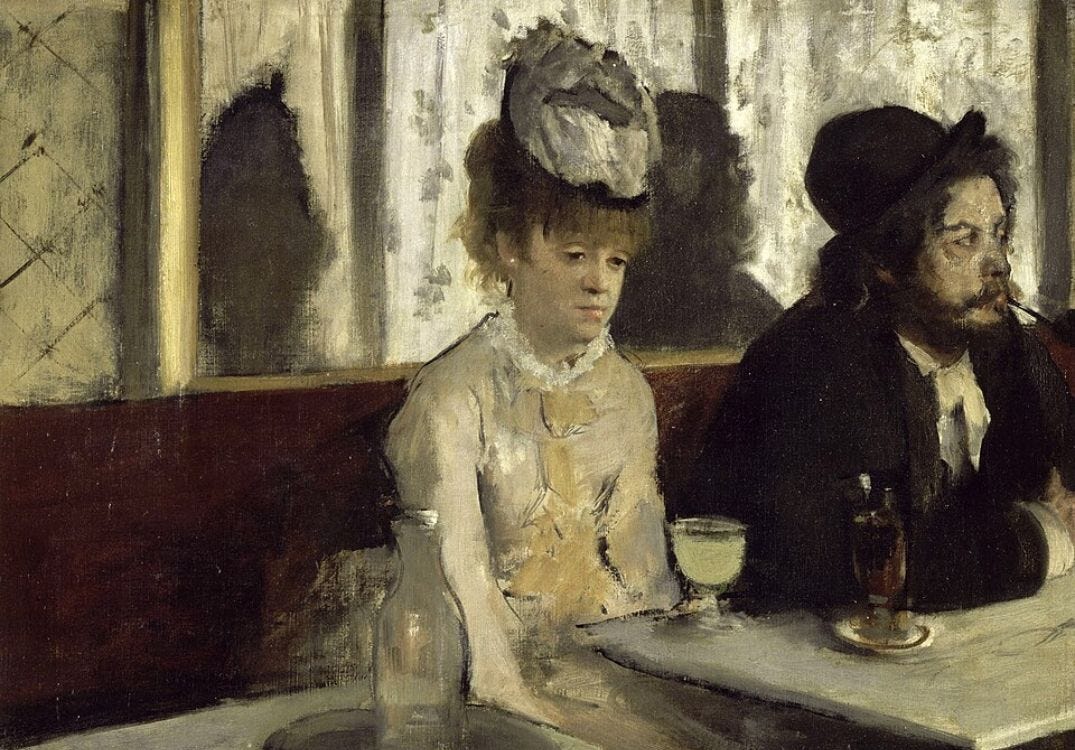
Edgar Degas, L’Absinthe. If you feel lost listening to French people while drinking Absinthe, your French may not be the only problem.
Here’s the truth nobody tells you in class: French is kind of sadistic. It doesn’t just happen to be hard to follow, it actively works to make itself harder to follow, at almost every level, on purpose. Here are the ten actual culprits, one by one.
1. Liaisons: letters that come back from the dead
You learned that French drops a lot of its final consonants. Mostly true. Except when a word starting with a vowel shows up right after, and suddenly that silent letter isn’t silent anymore. They’re coming back from the dead like in a classic Romero movie.
And because French couldn’t just leave it there, the letter doesn’t always come back sounding the way it looks. It shows up sounding like a different letter entirely.
A liaison with a final s turns into a z sound: les amis → “les-z-ami”
A liaison with a final d turns into a t sound: grand ami → “gran-t-ami”
A liaison with a final f turns into a v sound: neuf ans → “neu-v-ans”
2. Enchaînements: when three words become one long word
Similar idea, different mechanism. This time it’s not a hidden letter reappearing. It’s the normal end of one word sliding directly into the start of the next one, with zero gap between them.
There are two kinds, and I promise this is the only grammar-textbook part of this whole article. L’Enchaînement consonantique is when a word already ending in a pronounced consonant slides straight into the next word’s vowel, like elle_arrive, which runs together as one block of sound.
L’Enchaînement vocalique is the vowel version of the same thing, two vowel sounds bumping into each other with no pause, like tu_a(s)_écouté. Either way, your ear gets one long stretch of sound where your textbook promised you three neat little words.
More on enchaînements and liaisons together : Liaisons vs enchaînements
3. The letters that are technically there and never used
This is the one everyone eventually notices but nobody warns you about in advance: a huge number of “correct” French sounds just get dropped in casual speech, and it’s usually the E, but not only.
Je suis → j’suis
Petit → ptit
Tu es → t’es
This simple dropped letter actually causes a ton of trouble for my students when we’re trying to decode a scene from a film. Remember this: if you can’t understand a passage, it’s probably because a letter is missing somewhere. And most of the time, it’s je that becomes j’.
4. The words that just... leave
Some words don’t get shortened. They disappear entirely.
Ne in negation: je ne sais pas → je sais pas
Il in il y a: it vanishes completely, leaving y’a
Put those together: il n’y a pas becomes y’a pas
If you mentally scan a sentence for the grammatical markers you were taught to look for, and those markers are simply missing, you will not hear a “shortened sentence.” You will hear nothing you can recognize. French did not merely shorten the sentence; it removed your only reliable clue, leaving you to decipher the rest on your own.
5. Filler words polluting every sentence
Hein, ben, euh, donc, and yes, putain. French speech is stitched together with small noises and words that carry close to zero actual meaning but show up constantly. I once counted how many times my dad said "bon" in a five-minute phone call. Nine. Not one of them meant "good."
Nobody teaches these because they’re not “real” vocabulary. But if a huge percentage of what you’re hearing is filler, and you don’t recognize it as filler, you end up trying to translate air.
6. Slang — introduced way too late, if at all
Most teaching methods present slang as an option reserved for advanced learners. In reality, however, French people use it from the very first sentence of an informal conversation—not after ten years of friendship. A beginner who has learned only the “clean” version of French will find themselves stumped by words that a seven-year-old French child already knows.
I go deeper on this here: Les 50 mots d’argot les plus utilisés
7. Verlan, in a category of its own
Verlan is French back-slang, where you flip the syllables of a word, and it deserves its own bullet point because of how relentlessly it shows up. Meuf (femme), ouf (fou), chelou (louche) aren't rare or edgy exceptions. They're everyday words for a lot of French speakers, and there is no logical way to guess them from the original word alone unless someone's shown you the pattern. If you decide to become my student, you might learn meuf before femme, and that’s totally fine!
I wrote a full breakdown of verlan here: Podcast #39 : Le Verlan, le français à l'envers
8. Regional accents and regional words
The standard French taught in classes essentially corresponds to the French spoken in Paris, yet France is far more than just its capital. I grew up in the North, where people say “chicon” instead of “endive” and “wassingue” instead of “serpillière.” If you head south, the accent alone alters vowel pronunciation, and you will discover terms like “pitchoun” to refer to a child. Alsace and Lorraine have their own vocabulary and rhythm, shaped by their proximity to the German border. One country, but very different sounds.
Now imagine being raised in all three. You basically end up speaking a different language depending on where you are. That's actually my case.
9. Idiomatic expressions standing in for plain sentences
French people rarely just say the literal thing when there is a colorful expression sitting right there instead. Instead of saying something is easy, it’s simple comme bonjour. Instead of saying you’re broke, you’re fauché. Someone annoying is lourd, or worse, a total mood swing is avoir la moutarde qui monte au nez. Textbooks tend to teach the “functional” version of French first and save idioms for later chapters that a lot of learners never actually reach. Native speakers never got that memo.
More idioms broken down here: 50 expressions françaises avec les animaux or I Bet You’ve Never Heard of ‘Pédaler dans la choucroute’
10. Onomatopoeia doing half the talking
French people pepper their stories with onomatopoeia right in the middle of a sentence, even as adults, and without the slightest embarrassment. Hop for something moving quickly or effortlessly. Paf for a sudden event or something breaking. Tac tac tac for a rapid, repetitive action, like typing or footsteps. Pfff to express exasperation. You won’t find these expressions on a vocabulary list, yet a French person might slip three of them into a single story without even realizing it. At this point, you have to wonder if the language does it on purpose, just to watch you struggle.
So where does that leave you?
Knowing your enemy is the whole point here. The moment you know these ten things exist, you start catching them in real time instead of getting swallowed by them. Do that consistently and the wall of sound you started with turns into something you can actually pick apart.
Starting next month, this is exactly what we will be doing together in L’Apéro Spoken French, part of a new programme called L’Apéro Club. Live, every month, picking apart real clips from real French people, until every liaison, dropped word, and pfff actually makes sense instead of sliding right past you.
More details land in your inbox next week. For now, just know it’s coming.
À bientôt, Timo

Hey, I’m Timothée.
I write about the French language the way it’s actually lived: through cafés, music, awkward conversations, old expressions, cultural rituals, and all the small things textbooks usually forget.
If you enjoy learning French through stories, culture, music, and the hidden meaning behind words, you’ll probably enjoy the premium version of this newsletter.
Become a premium member and get access to full podcasts, translations, vocabulary notes, interactive exercises, and live workshops — all for about the price of a coffee each month.
If you enjoyed this content but don’t feel like subscribing just yet, you can always buy me a coffee. It’ll motivate me to create more content like this!
S'k tu vraiment penses Timo ?? 😹
The liaisons alway made it difficult for me to understand spoken French. I always found that if I listened for a few minutes I could understand the rhythm of the language.