

Think France is a wine country? Think again.
From the student bars of Lille to a tiny abbey hidden in the Belgian countryside, from the unwritten rules of the Parisian comptoir to a beer so rare the monks who brew it don’t even want you to find it, this episode is a love letter to the finest drinking culture in the world.
English Translation available at the end of the post.
Salut à tous, et bienvenue dans ce nouvel épisode de French with Timo.
Aujourd’hui, on va parler de bière. Et il faut que je vous raconte l’ironie du mois : en ce moment, je fais attention à ce que je mange et j’ai drastiquement réduit ma consommation d’alcool. Non, je n’étais pas alcoolique, rassurez-vous, mais j’ai pris cette décision juste avant la Coupe du monde de football. Un sacrilège me direz-vous, puisqu’en France, un match de foot sans bière, ça ne se fait tout simplement pas. Il ne me restait qu’une seule consolation : écrire un article sur la bière.
Et cet article a cartonné. Des centaines de notifications par jour, plus de 1000 nouveaux abonnés en trois semaines, et des commentaires parfois plus intéressants que l’article lui-même. Ce succès arrive aussi juste après une décision plus large : j’ai mis en pause tous mes réseaux sociaux, sauf Substack — oui oui, hein, c’en est un — pour écrire plus et scroller moins, parce que l’algorithme, c’est un peu comme une deuxième bière qu’on n’avait pas prévu de prendre, on se dit “juste une”, et puis ensuite on enchaîne. Merci également à tous les nouveaux abonnés payants : plus vous êtes nombreux, plus je peux passer du temps à créer du contenu pour vous.
Bon, passons au vrai sujet, et commençons par une idée reçue qu’on entend partout : “la France, ce n’est pas un pays de bière, c’est un pays de vin.” Sauf que les chiffres racontent une toute autre histoire. En 2025, pour la première fois, les Français ont bu plus de bière que de vin — 22,1 millions d’hectolitres de bière contre 22 millions d’hectolitres de vin, selon les Brasseurs de France et l’Organisation Internationale de la Vigne et du Vin. Et ce n’est pas un accident isolé : la France est aujourd’hui le pays qui compte le plus de brasseries en Europe, avec plus de 2300 brasseries en activité. Un Français boit en moyenne 33 litres de bière par an, et 70% de cette bière est produite directement sur le territoire. Bref, la bière française existe, elle est partout, et il est temps de s’y intéresser sérieusement.
Pour comprendre cette histoire, il faut remonter un peu dans le temps. Au Moyen Âge, ce sont les moines qui brassaient déjà, dans leurs abbayes — le mot “bierre” lui-même apparaît en français en 1435. Autrefois, cette boisson houblonnée s’appelait « cervoise », comme vous pouvez le constater dans les albums d’Asterix. Au début du XXe siècle, la France comptait plus de 3300 brasseries sur son territoire : un vrai âge d’or. Et puis, les deux guerres mondiales sont arrivées, et environ 90% de ces brasseries ont disparu, faute de moyens pour se reconstruire. Le secteur s’est alors standardisé autour de trois géants qui dominent encore aujourd’hui : Heineken France, AB InBev, et Kronenbourg. Il a fallu attendre les années 1980-90, et l’arrivée du mouvement craft beer venu des États-Unis, pour voir renaître une vraie diversité — avec des pionniers bretons comme la brasserie Lancelot ou Ninkasi, qui ont rouvert la voie à des milliers de microbrasseries dans le Nord et ailleurs.
Et le Nord, justement, mérite un détour. Le Nord de la France, c’est l’ancien pays des Flandres, et qui dit Flandres, dit houblon. Là-bas, la bière n’est pas une simple boisson, c’est une identité régionale. J’ai fait mes études de droit à Lille, et dans ma fac, il n’y avait pas un bar étudiant... il y en avait deux. On pouvait commander une pression entre deux cours de droit civil sans aucun jugement. Et tenez-vous bien : en 2021, c’est une bière du Nord, l’Anosteké, brassée par la Brasserie du Pays Flamand, qui a été élue meilleure bière blonde du monde aux World Beer Awards. Voilà qui devrait clouer le bec à ceux qui pensent encore que la France n’a rien à dire sur le sujet.
Côté marques, vous connaissez forcément les grands noms qu’on trouve partout en France : Kronenbourg et sa célèbre 1664, nées en Alsace, là où pousse le houblon Strisselspalt — mais aussi Pelforth, Fischer, Goudale, Desperados ou 3 Monts. Mais si on part en vrai tour de France des régions brassicoles, ça devient beaucoup plus intéressant. Dans le Nord, à côté de l’Anosteké, il y a La Bête, puissante mais peu amère, et Ducasse, une triple à 9 degrés qui doit son nom aux fêtes foraines locales — sans oublier la Jenlain, de la brasserie Duyck, la grande référence de la bière de garde, ce style typiquement français où la bière vieillit en cuve avant d’être mise en bouteille. En Corse, il y a la Pietra, à la châtaigne. En Provence, la Fada, brassée avec du romarin local. Au Pays Basque, l’Eguzki. Et à Paris, deux brasseries valent le détour : Demory, fondée en 1827, et Gallia, une microbrasserie de Pantin qui a repris le nom d’une ancienne brasserie parisienne disparue, comme pour réveiller cette mémoire brassicole de la capitale qu’on a un peu trop vite oubliée.
Maintenant, la question pratique : qu’est-ce qu’on commande en pression dans un bar français ? La grande majorité des bars proposent les mêmes pressions standards — 1664, Kronenbourg, ou de la Pelforth, qui dominent largement les volumes vendus en France. Si vous voulez monter légèrement en gamme sans sortir des sentiers battus, les pressions belges Leffe Blonde ou Grimbergen sont presque toujours disponibles, et restent un choix sûr. Mais si vous voulez vraiment impressionner, repensez à la phrase qu’on a vue dans l’article : “Vous avez quoi en pression ?” Dans un bar à bières ou une brasserie artisanale, cette question ouvre souvent la porte à une bière locale, parfois même brassée à quelques rues de là. C’est toujours plus intéressant qu’une 1664 de plus.
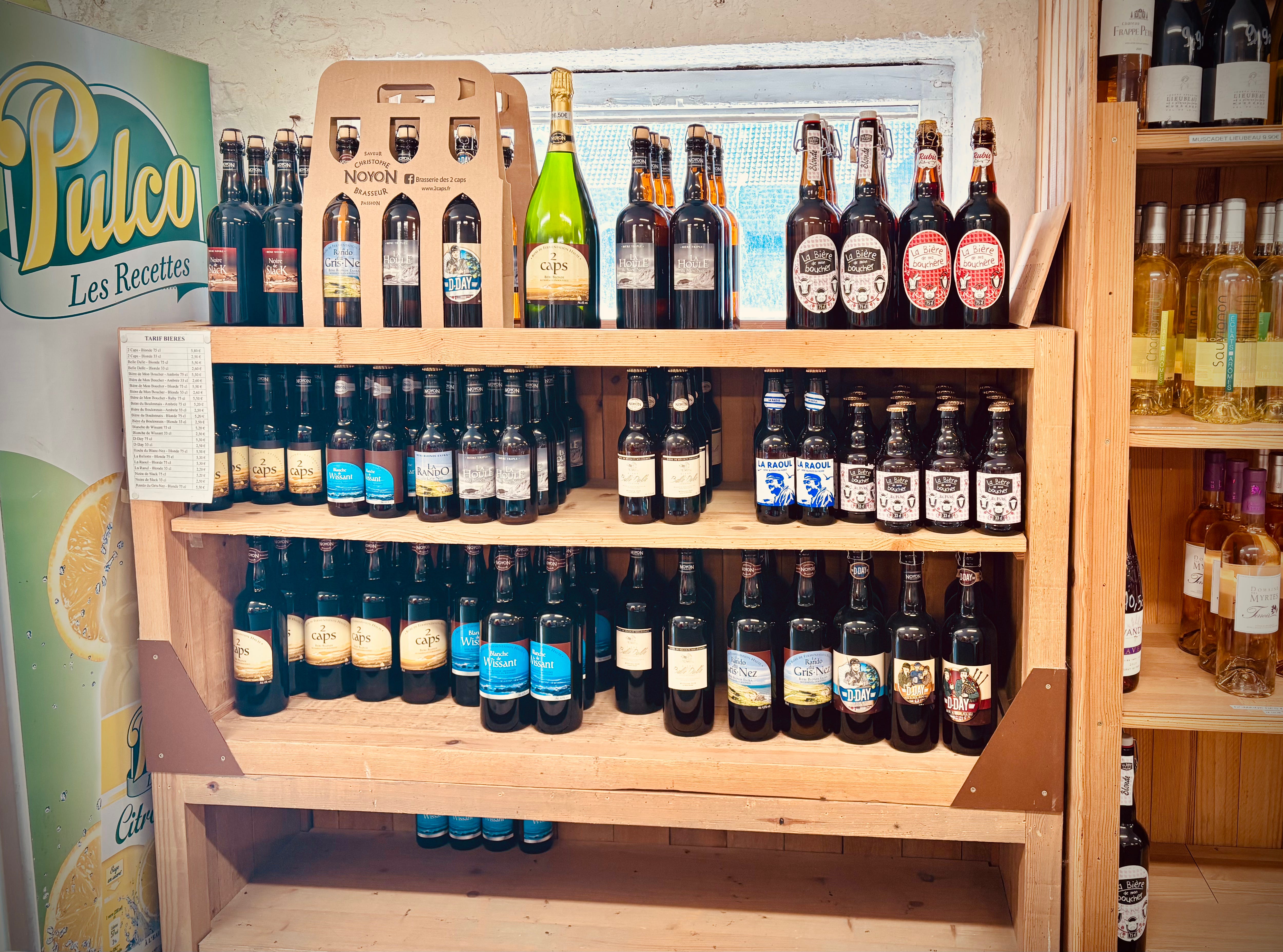
Si vous passez par la Côte d’Opale, faites un détour par la Brasserie des 2 Caps à Tardinghen. Leurs bières artisanales, notamment la Blanche de Wissant et la 2 Caps, valent largement le détour. Photo prise à la ferme Saint Pô, à Wissant.
Et puis, on traverse la frontière, direction notre cousine la Belgique. C’est pour moi, sans hésiter, le sommet mondial de la bière. Une petite histoire personnelle : pendant mes années à Lille, j’ai rencontré Florent, un Franco-Belge, sur les bancs de la fac et dans les vestiaires de rugby. Chaque été, Florent recrutait toute une équipe de Français pour aller travailler sur la côte flamande, en Belgique. C’est là-bas que j’ai travaillé comme barman, puis comme serveur. Et c’est là que j’ai appris LA règle absolue, presque religieuse, de la bière belge : chaque bière a son verre. Pas “un” verre, “son” verre, avec une forme spécifique, créée spécialement pour cette bière précise. Servez une Chimay dans le verre d’une Duvel, et vous verrez un Belge changer de visage en une seconde.
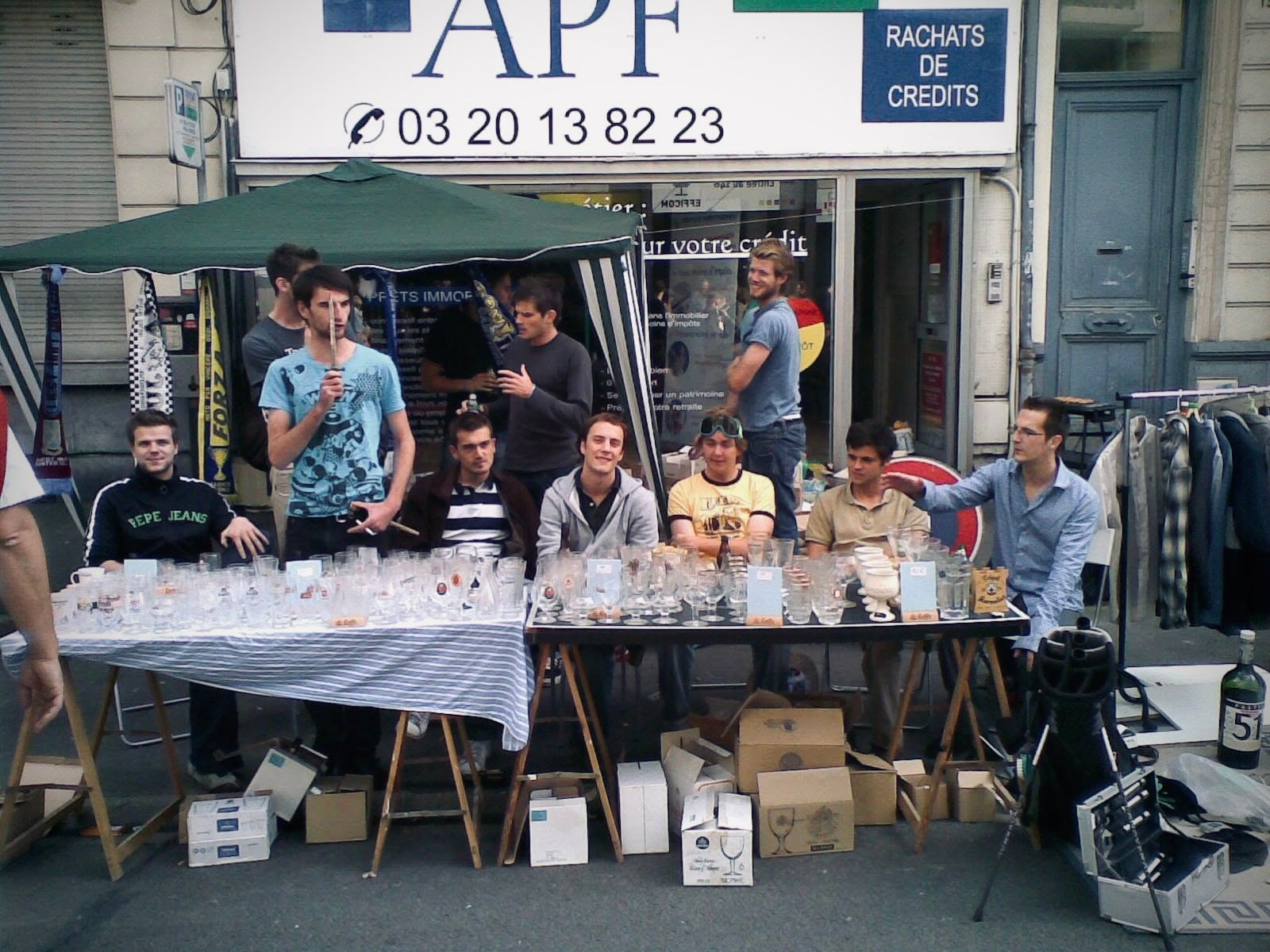
Vente de verres à bière belge à la braderie de Lille avec les copains, dans les années 2000. Je suis au centre… bière à la main.
Côté diversité, la Belgique reste à part. Il y a les bières trappistes, brassées dans des abbayes par des moines eux-mêmes — Chimay, Orval, Rochefort, Westmalle. Il y a les bières blanches, comme la Hoegaarden, légères et épicées. Et il y a les lambics et gueuzes, autour de Bruxelles, fermentées naturellement, sans levure ajoutée — un goût acide, presque comme du cidre, qu’on aime ou qu’on n’aime pas du tout.
Et puis, il y a elle. La légende : la Westvleteren. On dit que c’est la meilleure bière du monde — pas “une des meilleures”, LA meilleure, selon beaucoup de connaisseurs. Et là, je peux vous donner mon vrai avis, parce que je l’ai goûtée, plusieurs fois même. C’est en effet une très bonne bière, si vous aimez le style trappiste — forte, complexe, presque sirupeuse. Elle est brassée par des moines, à l’abbaye Saint-Sixte, et ces moines n’ont visiblement aucune envie de devenir riches : ils ont créé des règles très strictes pour limiter la vente. Première option, aller directement à l’abbaye, mais uniquement sur rendez-vous, avec une limite de deux caisses par personne. Deuxième option, plus simple : aller la boire dans le petit bar juste à côté de l’abbaye, le seul endroit autorisé à la servir. Pas de supermarché, pas de livraison (en fait si, c’est nouveau), pas d’exportation officielle. Juste des moines, leurs règles, et leur secret bien gardé. Et si vous vous demandez si ça vaut vraiment le coup, sachez que c’est la seule bière que — je connaisse — qui se boit à température ambiante.
Mais on n’a pas besoin d’aller jusqu’en Belgique pour vivre une bonne histoire de bar. Parfois, il suffit de se retrouver bloqué devant un stade à Paris un soir de match. C’est exactement ce qui est arrivé à Mike, un de nos lecteurs, qui a partagé ce souvenir dans les commentaires de l’article.
Il y a quelques années, Mike et ses amis étaient venus à Paris pour assister au match Angleterre-France au Parc des Princes. Problème : impossible d’entrer dans le stade. Direction le centre de Paris, rue Saint-Denis, à la recherche d’un bar avec une télé. Ils finissent par trouver un endroit un peu particulier — un bar avec, dans un coin, un système de paris sur les courses de chevaux — donc, en fait, un bar PMU — et des habitués qui suivaient les courses en vociférant.
Ils commandent plusieurs tournées à une table. À l’heure du coup d’envoi, ils demandent au barman de changer de chaîne pour le rugby. Ce qu’il fait. Consternation chez les parieurs. Mais le barman hausse les épaules et montre les nombreux verres vides sur la table du groupe — puis jette un œil aux habitués, qui, eux, ne consommaient pas grand-chose.
Le match commence. La France domine. L’ailier Émile Ntamack inscrit deux essais. Et peu à peu, les habitués se laissent embarquer par le jeu, devenant supporters du XV de France le temps d’une soirée.
Ils sont repartis bien plus tard, sous les sourires et les poignées de main, surtout celles du barman.
C’est exactement ce genre de situation — commander au bon moment, lire la salle, comprendre les codes — qu’on va travailler ensemble le mercredi 24 juin, lors d’un atelier en direct, réservé aux abonnés payants. On y verra les vraies interactions du bar français : comment commander sans passer pour un touriste, comment gérer une tournée entre amis, et comment demander l’addition — parce qu’en France, elle n’arrive jamais toute seule.
Si vous êtes déjà abonné payant, retrouvez le lien dans le chat des abonnés. Et si vous voulez nous rejoindre, c’est le moment parfait pour passer à l’abonnement premium.
Click below to get the access to the workshop in the subscriber chat:

Voilà pour cet épisode. La bière, en France et en Belgique, ce n’est jamais juste une boisson : c’est une région, une histoire, parfois même une religion. Merci à tous pour votre soutien ce mois-ci, et comme on dit au comptoir : à la tienne !
📖 Glossaire — La bière et le bar
Essential words from this episode, organised by theme.
La bière — Beer
Le houblon — the plant that gives beer its bitterness and aroma. No hops, no beer.
La pression / la bière pression — draft beer, poured directly from the keg and served at the bar. This is what you order at the counter.
Le fût — the large metal barrel that holds the beer in reserve, connected to the tap.
La tireuse — the tap system behind the bar used to serve draft beer.
Un demi — a 25cl glass of beer. The standard size in France.
Une pinte — a 50cl glass. Note: in France, une pinte is 50cl, not 56cl as in England.
La mousse — the white foam on top of a glass of beer. A good barman knows exactly how much to pour.
Une bière de garde — a typically French beer style from the North, aged in tanks before bottling. The Jenlain is the most well-known example.
Une bière trappiste — a beer brewed by monks in a Trappist abbey. Chimay, Westmalle, and Westvleteren are classic examples.
Un lambic / une gueuze — a Belgian beer fermented naturally, without added yeast. The taste is sour, almost like cider — you either love it or you don’t.
Brassé(e) — brewed. Cette bière est brassée à Lille — this beer is brewed in Lille.
Une brasserie — either a brewery where beer is made, or a restaurant-bar that serves food alongside drinks. Context changes the meaning entirely.
Une microbrasserie — a small craft brewery, usually local and independent.
Artisanal(e) — made in small quantities, with care, often locally. The opposite of industriel.
Le bar — The bar
Le comptoir — the bar itself, the long wooden or zinc surface behind which the barman works. Drinking au comptoir is cheaper than sitting at a table.
Le barman — the person serving drinks behind the counter.
Une tournée — a round of drinks, paid for by one person for the whole group. C’est ma tournée ! — It’s my round!
L’addition — the bill. In France, it never arrives on its own — you always have to ask for it.
Un habitué — a regular. Someone who comes to the same bar so often they have their own spot at the counter.
Un pilier de bar — literally “a bar pillar.” A vivid expression for someone who spends so much time at the bar they’ve practically become part of the furniture.
Expressions utiles — Useful expressions
Cartonner — to be a huge success. Mon article a cartonné — my article went down a storm.
Clouer le bec à quelqu’un — to shut someone up by proving them wrong. Literally “to nail someone’s beak shut.”
Lire la salle — to read the room. To sense the atmosphere without anyone spelling it out for you.
À la tienne ! — cheers, when drinking with one person. Plural: À la vôtre ! General: Santé !
🌾 D’où vient la bière ?
La bière est l’une des plus anciennes boissons du monde. On en retrouve des traces il y a plus de 5000 ans, en Mésopotamie — l’actuel Irak — où les Sumériens brassaient déjà une boisson fermentée à base d’orge. Ils avaient même une déesse dédiée à la bière : Ninkasi, dont le nom signifie littéralement “celle qui remplit la bouche”. Un signe que la bière, dès l’origine, était bien plus qu’une simple boisson.
Le mot “bière” lui-même a une histoire plus complexe qu’on ne le croit. Il viendrait du latin médiéval biber, qui signifie “boisson” ou “action de boire” — lui-même issu du verbe latin bibere, boire. Le mot apparaît en français pour la première fois en 1435, sous la forme “bierre”.
Mais pendant longtemps, ce qu’on buvait en France ne s’appelait pas encore “bière”. On disait cervoise — une boisson fermentée à base de céréales, mais sans houblon. C’est d’ailleurs ce mot qu’on retrouve dans les albums d’Astérix, où les Gaulois boivent de la cervoise autour du feu. Le houblon, lui, n’entre dans la fabrication de la bière qu’au Moyen Âge, vers le IXe siècle, introduit par les moines dans leurs abbayes. C’est cette plante qui va transformer la cervoise en bière telle qu’on la connaît aujourd’hui : plus amère, mieux conservée, et surtout, bien meilleure.
Un dernier détail amusant : le mot “cervoise” vient du latin cervesia, lui-même probablement lié à Cérès, la déesse romaine des moissons et des céréales. La bière, depuis le début, est une affaire de dieux.
🍺 Where to drink a good beer in Paris?
Jean’s firsthand observations — a longtime friend and beer specialist who has lived in Paris for over 15 years.
Before sharing his recommendations, Jean wants to flag something few tourist guides ever mention. In the North of France — in Lille, in Flanders, in craft breweries — bars systematically and regularly clean the lines that connect the keg to the tap. It’s a habit, almost a ritual. In Paris, that’s not always the case. And the consequences are real: when a bar switches beers without cleaning the lines, the flavours mix. The previous beer leaves residue in the lines, and the new one arrives with an unwanted aftertaste.
Jean experienced it himself: he ordered a Jenlain in a crêperie in Paris, only to find it had a cidery aftertaste, because the tap lines hadn’t been cleaned between the two.
So how do you avoid it? Simple: look for specialist beer bars: places where beer is the whole point, where staff know their equipment and actually take care of it.
Jean’s recommendations:
Quartier Latin
Le Mayflower — a neighbourhood institution, English pub feel, well-maintained taps.
Le 2 Bis Café — a low-key beer bar with a good selection and staff who know what they’re talking about.
Near Canal Saint-Martin / 10th arrondissement
Le Château d’Eau — genuine local atmosphere, well off the tourist trail.
Montparnasse
Le Falstaff, rue du Montparnasse — a reliable choice, recommended by Jean for the consistently good quality of its draft beer.
My own recommendations:
Paris has more to offer than most people think, you just need to know where to look. These three places are worth the detour.
Hoppy Corner — one of the best craft beer selections in Paris, with a constantly rotating tap list and a team that genuinely loves what they serve. If you want to discover French microbreweries without leaving the city, start here.
La Fine Mousse — a landmark in the Parisian craft beer scene. Both a bar and a bottle shop, it’s the kind of place where you can spend an hour just reading the menu. The staff will guide you without making you feel judged for not knowing every brewery by heart.
La Ruée vers l’Orge — the name is a play on la ruée vers l’or, the gold rush — except here, the gold is in the glass. A warm, unpretentious spot with a serious selection and the kind of regulars who actually know what they’re drinking.
Between Jean’s addresses and these three, you have no excuse to ever settle for a mediocre pression in Paris again.
J’espère que cette épisode vous a plu et je vous promets que je reviendrai bientôt avec un épisode sur le vin dans les prochaines semaines.
À bientôt,
Timo
English Translation:
Hi everyone, and welcome to this new episode of French with Timo.
Today, we’re talking about beer. And I have to share the irony of the month: right now, I’m watching what I eat and I’ve drastically cut back on alcohol. No, I wasn’t an alcoholic, don’t worry — but I made that decision just before the Football World Cup. Sacrilege, you might say, because in France, watching a football match without a beer simply isn’t done. My only consolation: writing an article about beer.
And that article was a huge hit. Hundreds of notifications a day, over 1000 new subscribers in three weeks, and comments that were sometimes more interesting than the article itself. This success also comes right after a bigger decision: I put all my social media on pause — except Substack, which, let’s be honest, is a social network too — to write more and scroll less. Because the algorithm is a bit like that second beer you didn’t plan on having: you tell yourself “just one,” and then one leads to another. A big thank you also to all the new paying subscribers: the more of you there are, the more time I can spend creating content for you.
Right, let’s get into the real subject — and let’s start with a misconception you hear everywhere: “France isn’t a beer country, it’s a wine country.” Except the numbers tell a different story. In 2025, for the first time, the French drank more beer than wine — 22.1 million hectolitres of beer against 22 million hectolitres of wine, according to the Brasseurs de France and the International Organisation of Vine and Wine. And it’s not a one-off: France is now the country with the most breweries in Europe, with over 2,300 active breweries. The average French person drinks 33 litres of beer a year, and 70% of that beer is produced right there on French soil. In short: French beer exists, it’s everywhere, and it’s time to take it seriously.
To understand this story, we need to go back in time. In the Middle Ages, it was monks who were already brewing, in their abbeys — the word “bierre” itself first appears in French in 1435. Back then, this hopped drink was called cervoise — as you can see in the Asterix comics, where the Gauls drink cervoise around the fire. At the start of the 20th century, France had over 3,300 breweries: a true golden age. Then the two World Wars arrived, and around 90% of those breweries disappeared, without the means to rebuild. The industry then consolidated around three giants that still dominate today: Heineken France, AB InBev, and Kronenbourg. It wasn’t until the 1980s and 90s, with the arrival of the craft beer movement from the United States, that real diversity returned — led by Breton pioneers like the Lancelot and Ninkasi breweries, who paved the way for thousands of microbreweries in the North and beyond.
And the North, in particular, deserves a closer look. The North of France is the old land of Flanders — and where there’s Flanders, there’s hops. Up there, beer isn’t just a drink, it’s a regional identity. I studied law in Lille, and at my university, there wasn’t one student bar… there were two. You could order a draft beer between two civil law lectures without anyone raising an eyebrow. And here’s the thing: in 2021, it was a beer from the North — the Anosteké, brewed by the Brasserie du Pays Flamand — that was named the best blonde beer in the world at the World Beer Awards. That should silence anyone who still thinks France has nothing to say on the subject.
On the brand side, you’ll certainly know the big names found everywhere in France: Kronenbourg and its famous 1664, born in Alsace where the Strisselspalt hop grows — but also Pelforth, Fischer, Goudale, Desperados, and 3 Monts. But if you go on a real tour of France’s brewing regions, things get much more interesting. In the North, alongside the Anosteké, there’s La Bête — powerful but not too bitter — and Ducasse, a triple at 9% named after the local fairground festivals. And then there’s the Jenlain, from the Duyck brewery, the benchmark for bière de garde — that typically French style where the beer ages in tanks before being bottled. In Corsica, there’s the Pietra, brewed with chestnut. In Provence, the Fada, made with local rosemary. In the Basque Country, the Eguzki. And in Paris, two breweries are worth the detour: Demory, founded in 1827, and Gallia, a microbrewery in Pantin that revived the name of a long-lost Parisian brewery — as if to reawaken a brewing memory the capital had too quickly forgotten.
Now, the practical question: what do you actually order on draft in a French bar? The vast majority of bars offer the same standard options — 1664, Kronenbourg, or Pelforth, which dominates volumes sold in France. If you want to step up slightly without straying too far, Belgian drafts like Leffe Blonde or Grimbergen are almost always available and are a safe bet. But if you really want to impress, think back to the phrase from the article: “Vous avez quoi en pression?” — “What do you have on draft?” In a beer bar or craft brewery, that question often opens the door to a local beer, sometimes brewed just a few streets away. Always more interesting than another 1664.
Then we cross the border — into Belgium. For me, without hesitation, the world capital of beer. A personal story: during my years in Lille, I met Florent, a Franco-Belgian, on the university benches and in the rugby changing rooms. Every summer, Florent would recruit a whole team of French people to go and work on the Flemish coast in Belgium. That’s where I worked as a barman, then as a waiter. And that’s where I learned THE absolute rule — almost a religious one — of Belgian beer: every beer has its glass. Not “a” glass — “its” glass, with a specific shape designed exclusively for that particular beer. Serve a Chimay in a Duvel glass, and you’ll watch a Belgian’s face change in an instant.
In terms of variety, Belgium stands apart. There are the Trappist beers, brewed in abbeys by the monks themselves — Chimay, Orval, Rochefort, Westmalle. There are the white beers, like Hoegaarden — light and spiced. And there are the lambics and gueuzes, from around Brussels, fermented naturally without added yeast — a sour taste, almost like cider, that you either love or absolutely don’t.
And then there’s her. The legend: the Westvleteren. Said to be the best beer in the world — not “one of the best,” THE best, according to many connoisseurs. And here I can give you my honest opinion, because I’ve tasted it — several times, in fact. It is indeed a very good beer, if you enjoy the Trappist style — strong, complex, almost syrupy. It’s brewed by monks at the Saint-Sixtus Abbey, and those monks clearly have no interest in getting rich: they’ve set very strict rules to limit sales. Option one: go directly to the abbey, but only by appointment, with a limit of two cases per person. Option two, simpler: drink it at the small bar right next to the abbey — the only place in the world officially authorised to serve it. No supermarkets, no delivery, no official exports. Just monks, their rules, and their well-kept secret.
But you don’t need to go all the way to Belgium for a great bar story. Sometimes all it takes is being locked out of a stadium in Paris on match night. That’s exactly what happened to Mike, one of our readers, who shared this memory in the comments of the article.
A few years ago, Mike and his friends had come to Paris to watch the England-France match at the Parc des Princes. Problem: no way to get in. So they headed to the centre of Paris, Rue Saint-Denis, looking for a bar with a TV. They ended up somewhere rather unusual — a bar with, in one corner, a horse racing betting setup, and a crowd of regulars glued to the racing screens, shouting loudly.
They ordered several rounds at a table. When kick-off time came, they asked the barman to switch to the rugby. Which he did. Consternation among the betting crowd. But the barman just shrugged, pointed to the large number of empty glasses on the group’s table — then glanced over at the regulars, who weren’t really drinking much at all.
The match started. France dominated. Winger Émile Ntamack scored twice. And gradually, the regulars — many of whom were of West African origin — were drawn into the game, becoming France supporters for the evening.
They left much later, to smiles and handshakes all round — especially from the barman.
That’s exactly the kind of situation — ordering at the right moment, reading the room, understanding the unwritten codes — that we’re going to work on together on Wednesday 24th June, in a live workshop reserved for paying subscribers. We’ll cover the real interactions of a French bar: how to order without looking like a tourist, how to handle a round of drinks with friends, and how to ask for the bill — because in France, it never arrives on its own.
If you’re already a paying subscriber, you’ll find the link in the subscriber chat. And if you’d like to join us, now is the perfect time to upgrade to a premium subscription.
That’s it for this episode. Beer, in France and in Belgium, is never just a drink — it’s a region, a history, sometimes even a religion. Thank you all for your support this month, and as they say at the bar: à la tienne! Cheers!