


It pains me to say this but I tell my intermediate students the same thing almost every time: don’t start with novels.
French literature is magnificent. But so much of it is also dense, literary, and full of the passé simple, a tense you’d rarely hear spoken aloud and that can trip up even advanced learners. Reading Flaubert or Zola before you’re ready doesn’t make you cultured. It makes you miserable. And demotivated. And, frankly, it makes you quit.
So here’s what I recommend instead: theatre.
Plays are almost entirely dialogue. The sentences are short, punchy, and built to be spoken out loud. The language feels alive because it is alive since it was written to be heard, not studied. You can read a character’s line and imagine yourself saying it. You can steal phrases directly and use them in real conversations.
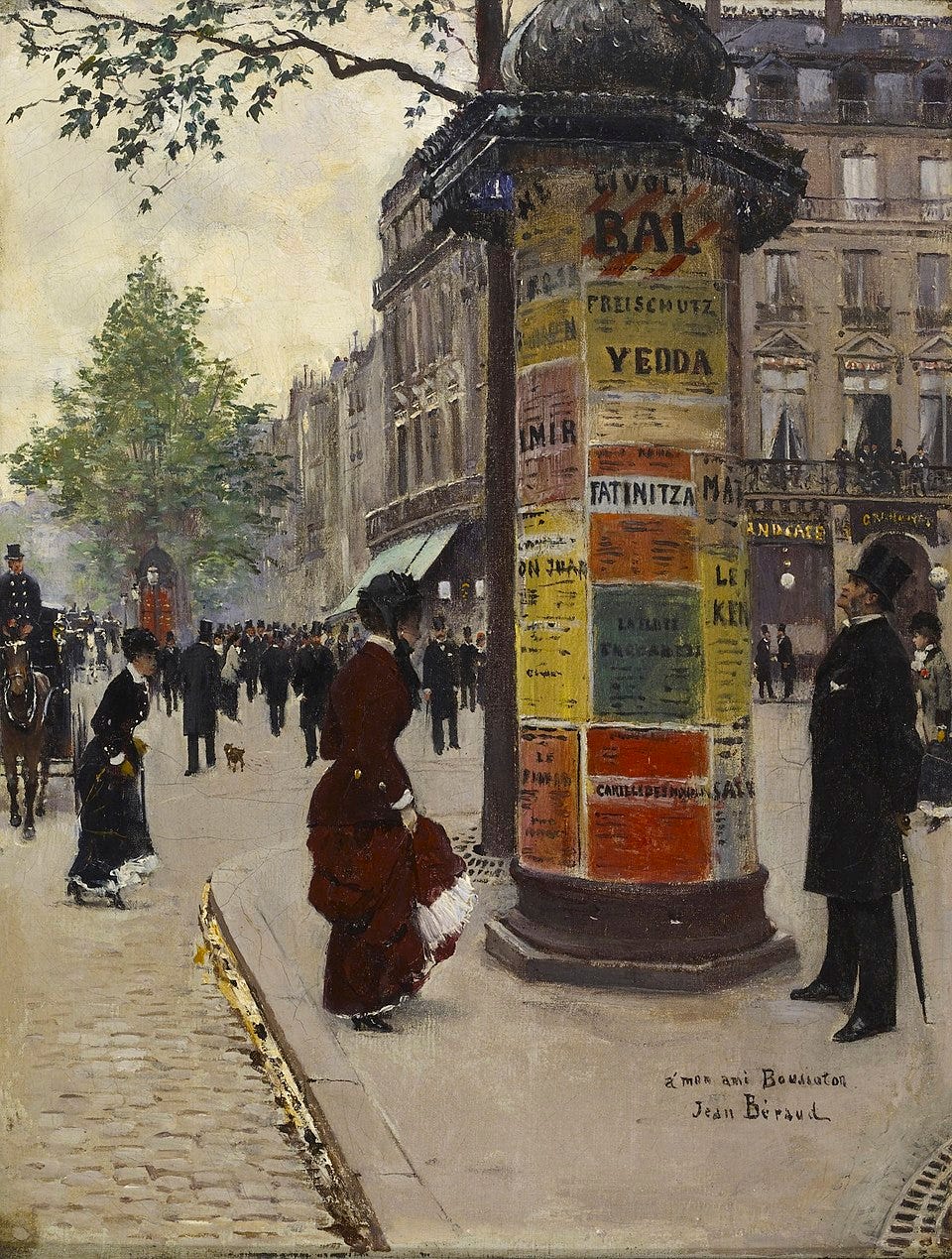
Jean Béraud, Colonne Morris (entre 1880 et 1884)
Here are five plays I recommend if you want to practice your French.
And this Friday, I’ll share lots of tips on how to read in French more effectively in my new podcast. Make sure you’re subscribed.
Still determined to read a novel? No judgement, I get it. In that case, I’ve put together a separate list of 5 French Classic Books You Can Actually Understand, chosen specifically for their accessible style and modern language.
1. Knock, ou le Triomphe de la médecine — Jules Romains
Written in 1923, it’s the story of a dodgy doctor who arrives in a small village and convinces every healthy resident that they’re secretly ill. It sounds absurd but it’s also sharp, funny, and oddly timeless.
What makes it great for learning is that the dialogue is simple, rhythmic, and full of repetition. The kind of repetition that actually helps things stick. You’ll be smiling and learning French at the same time, which is exactly how it should feel.
2. Rhinocéros — Eugène Ionesco
People are turning into rhinoceroses. One by one. And the town just sort of... accepts it.
I have a confession to make about this one. My French teachers at school always told us to read Ionesco. I didn’t. I was that student, the one who did the opposite of whatever was recommended, on principle. A few decades later, I finally picked it up and thought: okay, they were right. I was wrong. Mais mieux vaut tard que jamais, non ?
Behind the absurd comedy there’s something darker, a reflection on conformism and how societies go along with the unthinkable. But honestly, you don’t need to think about any of that to enjoy it. The language is repetitive, circular, almost playful, and much more accessible than you’d expect from something so famous.
If you want more Ionesco after this, La Cantatrice chauve and La Leçon are the obvious next steps.
If you enjoy learning French through stories, films, music and the hidden meaning behind words, you’ll probably enjoy the premium version of this newsletter.
Become a premium member to get full access to the application (frenchwithtimo.com) and blog (learnfrenchwithtimo.com), complete podcasts with transcripts, vocabulary notes, interactive exercises, cultural deep dives, the private subscribers’ chat, and a seat at L’Atelier, my monthly live conversational workshop.
You’ll also receive The Honest French Guide: practical, honest advice to help you navigate the French language and culture naturally.
All for the price of a coffee each month.
3. Art — Yasmina Reza
Three friends. One very expensive all-white painting. One very bad reaction. What starts as a disagreement about art slowly turns into a crisis about the friendship itself. Fifteen years of things left unsaid all coming out at once.
Yasmina Reza is one of the biggest names in contemporary French theatre, and Art is her most famous work, translated into over thirty languages. The French is clean, modern, and easy to follow. Honestly, it’s one of those plays where you forget you’re studying and just want to know what happens next.
4. Cuisine et dépendances — Agnès Jaoui & Jean-Pierre Bacri
A dinner party. Old friends who haven’t seen each other in a while. Awkward silences, half-finished sentences, and all the things people say when they mean something completely different.
You already know Bacri from my spoken French video published a few weeks ago, the one on Le Sens de la fête. Well, before he was a filmmaker, he was a playwright. And this is where it all started. He and Agnès Jaoui wrote dialogue the way people actually talk: interrupting each other, trailing off, saying exactly the wrong thing at exactly the wrong moment.
This one is particularly useful if your goal is to actually speak French, not just read it. The register is everyday, the situations are familiar, and you’ll walk away with phrases you can use immediately.
5. Huis clos — Jean-Paul Sartre
Three strangers are locked in a room together. In hell. And there’s no way out. That’s the whole setup, and Sartre does extraordinary things with it.
“L’enfer, c’est les autres.” Hell is other people. You’ve probably heard the line. This is where it comes from. I’ll be honest, this is my personal favourite on this list. There’s something about the claustrophobia, the tension, the way the characters slowly reveal themselves, that I find completely gripping every time I read it. Sartre’s writing here is surprisingly clear and direct, much more so than his philosophical essays.
If it hooks you, Les Mouches and Les Mains sales are the natural next reads.
Most of these are accessible from B1 upwards, and Knock can work even at A2 with a bit of patience. Don’t worry about understanding every word. Read for the story first, then go back for the language. Reading aloud, even to yourself, is never a waste of time with theatre.
And if you find yourself reaching for your phone every two minutes to look something up, consider getting a bilingual edition. They exist for most of these plays, and there’s absolutely no shame in having the translation right there on the facing page. It keeps you in the flow of the story, which is the whole point.
💬 Have you read any of these? Do you have a favourite French play that helped you make progress? Tell us in the comments!
On se voit vendredi lors du prochain podcast pour approfondir ce sujet !
À bientôt !
Timothée
J'ai hâte de jeter Voltaire et commencer au théâtre ! 😉
Salut Tim ~ Like others, I love this advice but I must question two choices. The "words" may be simple but understanding the meaning of the works ... not so much. Ionesco? An absurdist work, where the real meaning of the piece is not obvious. (This goes for any of his plays.) And Sartre? Same. Avant-gard theatre. Terrific piece on the stage under expert direction. For theatre students, great stuff. French learners? Hmmm. I suppose La Malade Imaginaire or Cyrano de Bergerac would be too much "old" language but at least we might learn humor from French masters!