


For almost a year now, I’ve been running experiments in a secret laboratory. Don’t bother looking for it on the blog: it’s hidden inside another program. The project’s code name is Décrypte le français, and every now and then I let a few results escape into my Spoken French articles.
Some experiments are fun. Others go horribly wrong. I can still picture my test subjects’ crestfallen faces when I revealed that « kchtépas » was actually « que je ne t’ai pas ». So I try to vary the dosage.
When my subjects complain a little too loudly, I tell them not to worry if it feels too hard. First of all, this is how French people actually talk. You’re better off suffering in a group in class, or alone at home in front of your screen, than during your next conversation in France. And the more you train on difficult material, the easier the gentler stuff will feel. It’s like at the gym: you increase the load to make the workout more intense, and that way you’re better prepared to face everyday life.
But nobody starts lifting with 100 kilos, not even in a mad scientist’s basement. If you’re a beginner, stick to simpler resources and treat mine as challenges. On Friday, in the podcast, I will prescribe a few resources for your level.
After a year of experiments on my guinea pigs, I know exactly what makes them scream the loudest when it comes to listening comprehension.

Welcome to the cemetery
You learned « Je ne sais pas ». You ask for directions in Paris and get « chépa ». Four syllables went in, two came out.
The French write using every letter but speak by omitting everything else. No one is trying to confuse you: people speak quickly, and anything that isn’t essential to the meaning ends up being omitted. The problem is that it’s often those very elements that you need.
The « ne » of negation: missing in action
This is the famous one. In everyday conversation, the ne gets dropped the vast majority of the time. It survives in writing, in speeches, when someone reads a text aloud. At the café, much less.
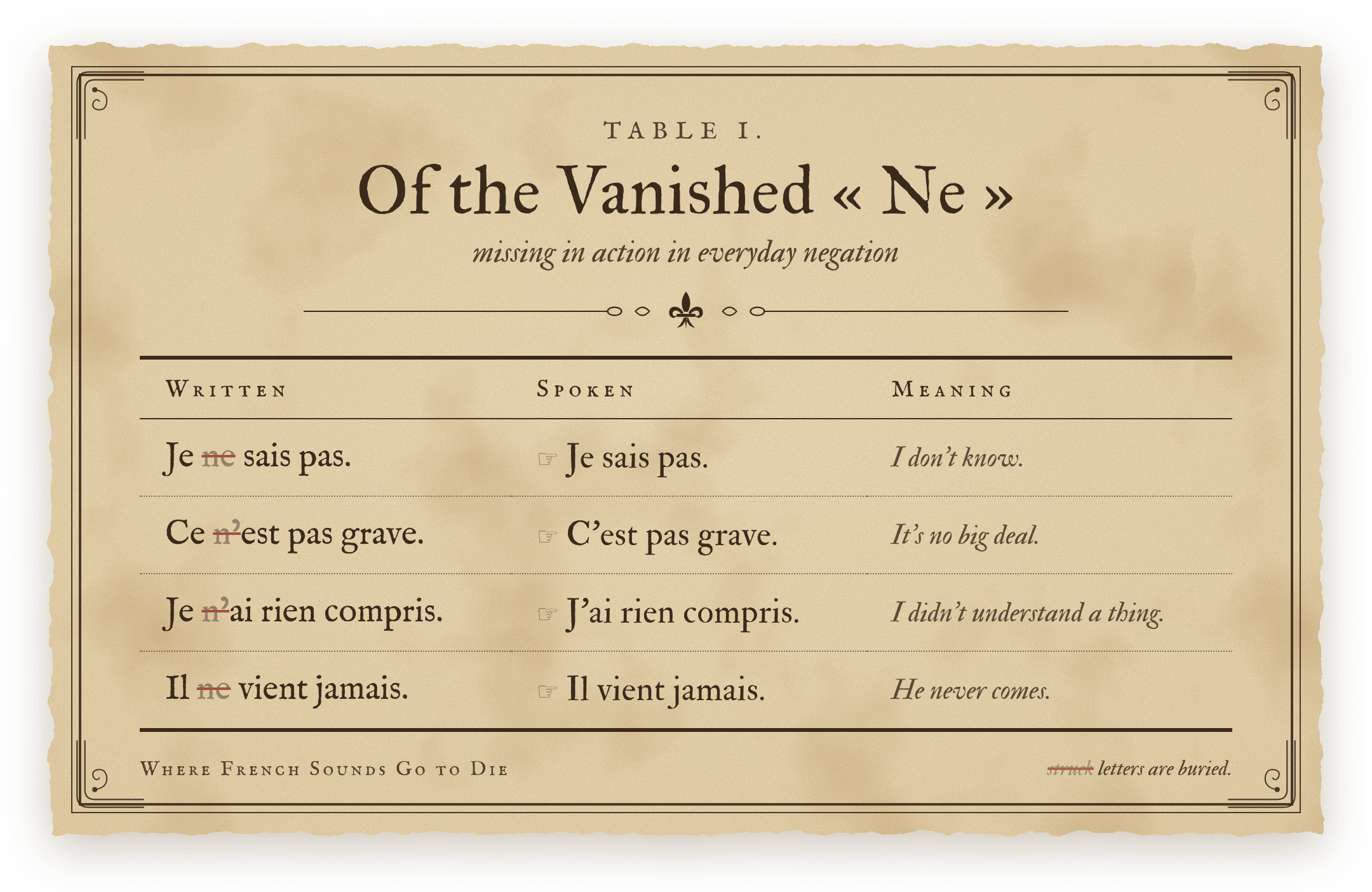
The negation hasn’t gone anywhere, though: it’s carried entirely by pas, plus, jamais, rien, personne. So the second half is the one to listen for.
Three traps my guinea pigs know well:
Ne… que. « J’ai que dix euros » means I only have ten euros. Without the ne, there’s no negative word left for your ear to catch. The whole meaning rests on that little que.
Ne… plus. « J’en veux plus. » If you don’t hear the S in plus, it’s I don’t want any more. If you do hear it (« pluss »), it’s I want more.
On n’a / on a. Out loud, « on n’a pas » and « on a pas » sound exactly the same, because of the liaison. Even French people forget the n’ when they write.
The silent « e »: the ghost
Linguists call it the schwa, or e caduc. I call it the ghost: you can see it on the page, but most of the time it never makes a sound.
In short words (je, me, te, se, le, de, ce, que, ne), it drops most of the time:
Je te dis → J’te dis (I’m telling you).
When small words pile up, one e usually survives.
Je te dis → J’te dis (I’m telling you). Careful, though: not « j’t’dis ». That’s one e too many gone. You might hear it in some corners of France, but it’s far from elegant.
Tu me le donnes ? → Tu m’le donnes ? (Will you give it to me?)
Je regarde le match → J’regarde le match (I’m watching the game)
Pas de souci → Pas d’souci (No problem)
Je me demande ce que tu fais → J’me d’mande c’que tu fais (I wonder what you’re doing)
Inside longer words too. That’s where it gets nasty, because the word changes shape:
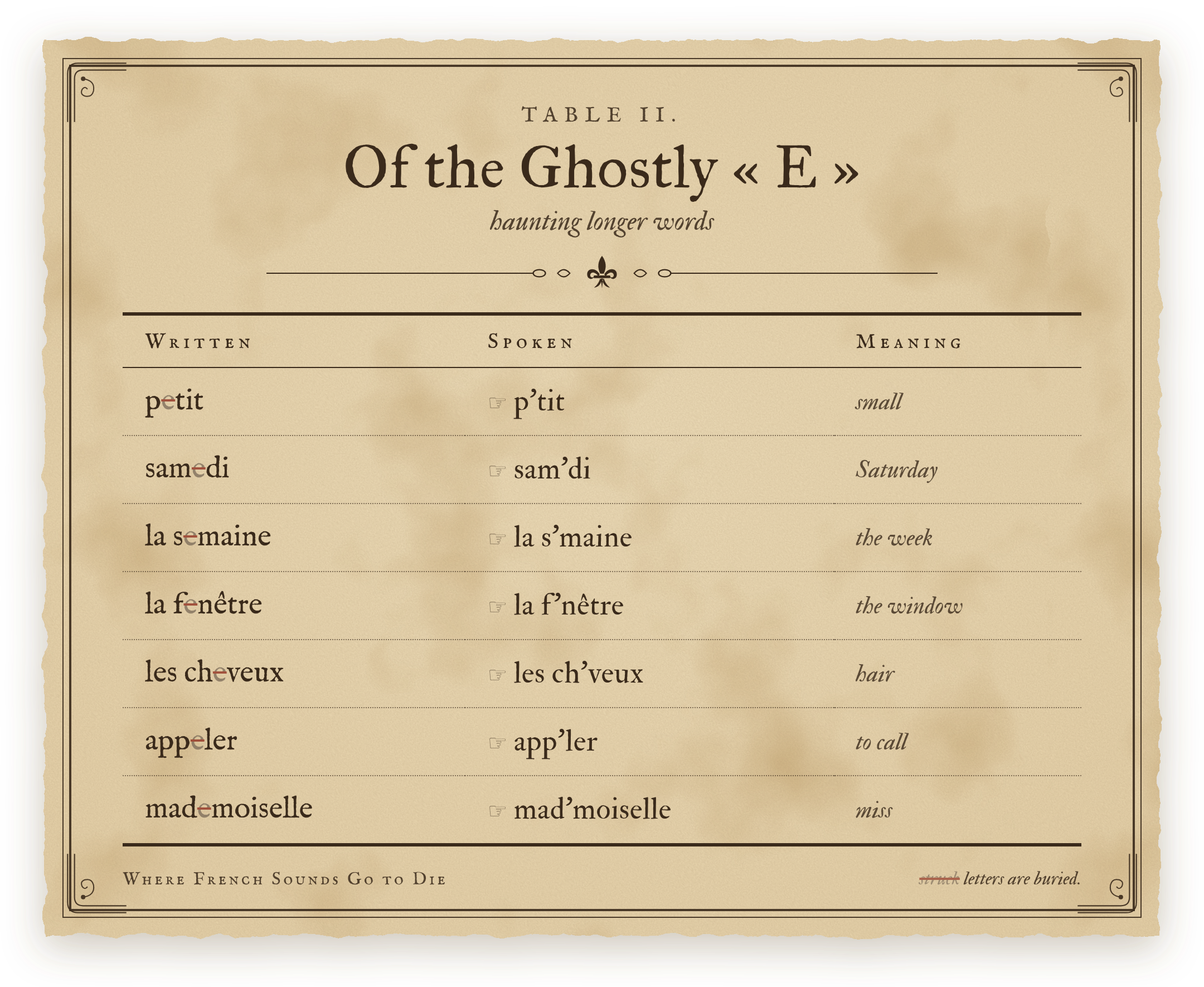
Same thing in the future and conditional: je mangerai becomes « j’mang’rai », j’aimerais becomes « j’aim’rais ».
So why do some e’s hold out? Roughly speaking, French doesn’t like stacking three consonants in a row. That’s why samedi loses its e (« sam’di ») but vendredi keeps it: without the e, you’d get D, R and D back to back, and nobody says « vendr’di ». It’s more of a habit than a rule, but it explains why the ghost haunts some words and not others.
Quick geographical detour: in the South of France, that final e hangs on much better. Someone from Marseille will happily say « comme-eu ça » in three syllables. A Parisian will use about one and a half.
When « je » turns into « ch »
Once the e in je is gone, the J ends up stuck right against the next consonant. If that consonant is one you say without your vocal cords vibrating (S, P, T, F, K), the J loses its buzz too and turns into CH. Put your hand on your throat and say « ssss », then « zzzz »: only the second one vibrates.
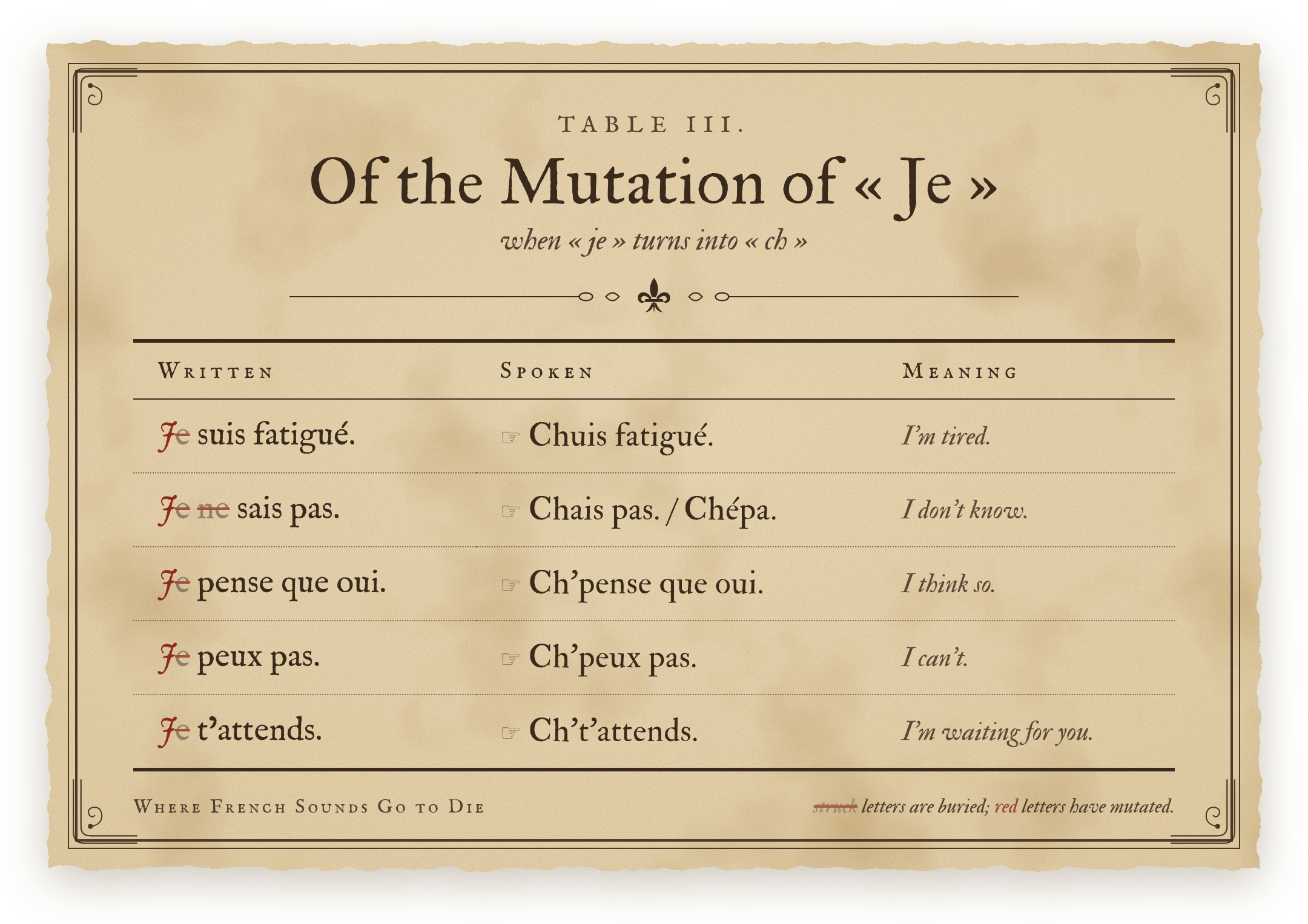
Before a buzzing consonant (V, D, R, M…), the J keeps its buzz and stays a J: « j’vais », « j’regarde », « j’me lève ».
If you’ve ever looked up chuis in the dictionary, don’t worry: half my students have done the same.
The impersonal « il »: evaporated
When il doesn’t refer to anyone (the il in il y a, il faut, il pleut), it simply vanishes. The sentence starts straight with the verb, which makes some people think they’re hearing an imperative.
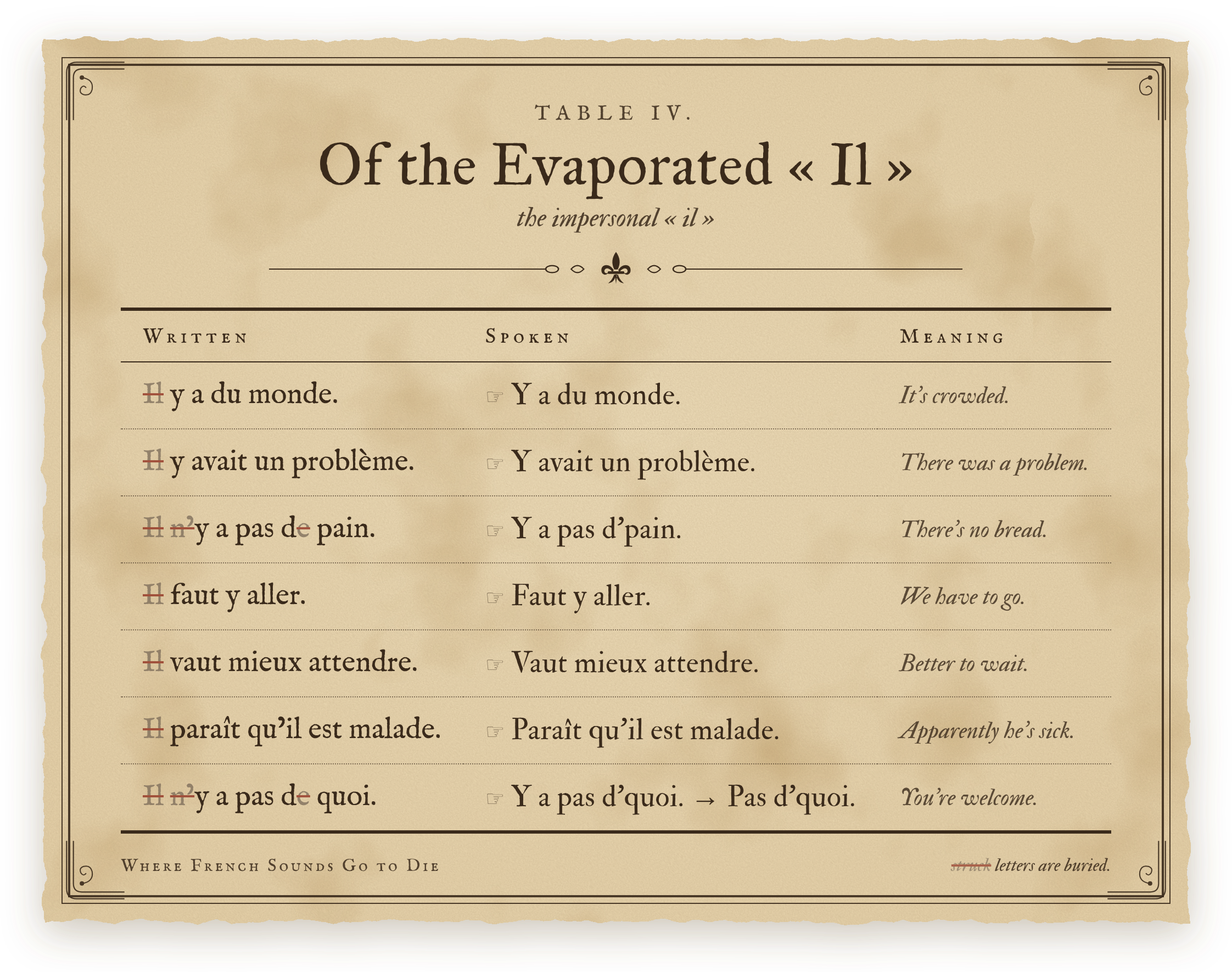
« Il n’y a pas de pain » turning into « Y a pas d’pain » is three disappearances at once: the il, the n’, and the de losing its e.
« Tu » loses its U
Before a vowel, tu shrinks down to a T.
Tu es où ? → T’es où ? (Where are you?)
Tu as vu ? → T’as vu ? (Did you see?)
Tu avais raison. → T’avais raison. (You were right.)
Tu aimes ça ? → T’aimes ça ? (Do you like that?)
It even happens before a consonant in a few set phrases: tu sais (you know) becomes « t’sais ».
Watch out for « t’as », which sounds exactly like ta (the possessive). « T’as vu ta tête ? » (Have you seen your face?) is a perfectly correct spoken sentence. And a mildly insulting one.
Word endings that crumble
When a word ends in a consonant followed by R or L (quatre, autre, possible), the R or L often drops, especially when the next word starts with a consonant.
quatre personnes → quat’ personnes (four people)
autre chose → aut’ chose (something else)
notre voiture, votre maison → not’ voiture, vot’ maison (our car, your house)
Je vais le mettre là → J’vais l’mett’ là (I’ll put it there)
You’ll notice that last sentence already stacks up three disappearances. We’ll come back to that.
Words that melt in the sun
Some very common words have been used so much that they’ve worn down, like an old stair step.
parce que → pasque (because)
puis → pis, as in « et pis après… » (and then)
quelque chose → quèque chose (something)
peut-être → p’t-être, or even p’têt (maybe)
monsieur → m’sieur (sir)
bien → ben, as in « eh ben »
Night of the living dead: when it all comes together
None of these things happens on its own. In a real sentence, they pile up. Let’s take a very innocent one:
« Je ne sais pas ce que tu veux. » (I don’t know what you want.)
Drop the ne: Je sais pas ce que tu veux. Variante possible : Je n’sais pas ce que tu veux.
Drop the e‘s: J’sais pas c’que tu veux.
J before S becomes CH: Chais pas c’que tu veux.
What actually reaches your ear: « chépaskeutuveu ». One mushy blob, delivered in a second. This is everyday French, by the way, the kind your bank advisor speaks outside office hours.
A few more for practice:
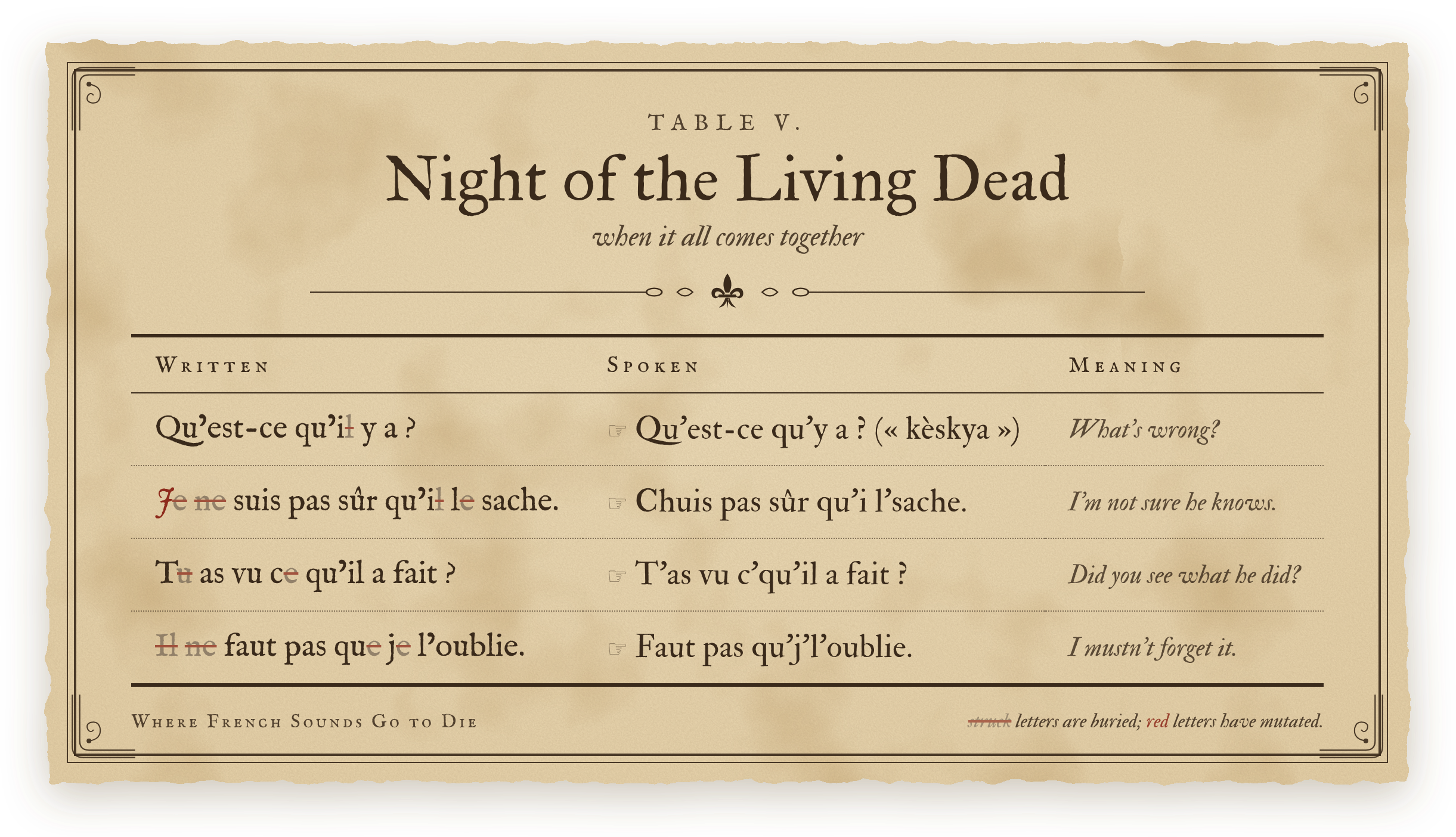
My mad-scientist tip
Don’t try to memorize these forms so you can use them yourself. The goal is to recognize them. Your written French should stay clean (your emails, your messages to your Airbnb host). Your ear, on the other hand, needs to know that « chépa » and « je ne sais pas » are the same animal.
The method that works for my students: Take a short clip (thirty seconds, one minute), listen to it several times without subtitles, and then try to reconstruct the entire written sentence. At first, you’ll only catch bits and pieces. That’s normal. After a few weeks, the “y a,” “chuis,” and “faut” will start jumping out at you on their own.
So what do we practice with?
That’s for Friday. In this week’s podcast, I’ll give you my recommendations level by level, from beginners who need French people who actually articulate, all the way to advanced learners ready to take on « kchtépas » at full speed. The podcast is for paid subscribers.
Paid subscribers can also download the full cheat sheet: all ten families of vanishing sounds, on two printable pages.
Download the cheat sheet:
Until your next conversation in France, keep training your ears. And may your « ne » rest in peace.
Adieu,
Timo
