


I’ll tell you exactly when football — le football, or just le foot, as everyone actually says — got its hooks into me.
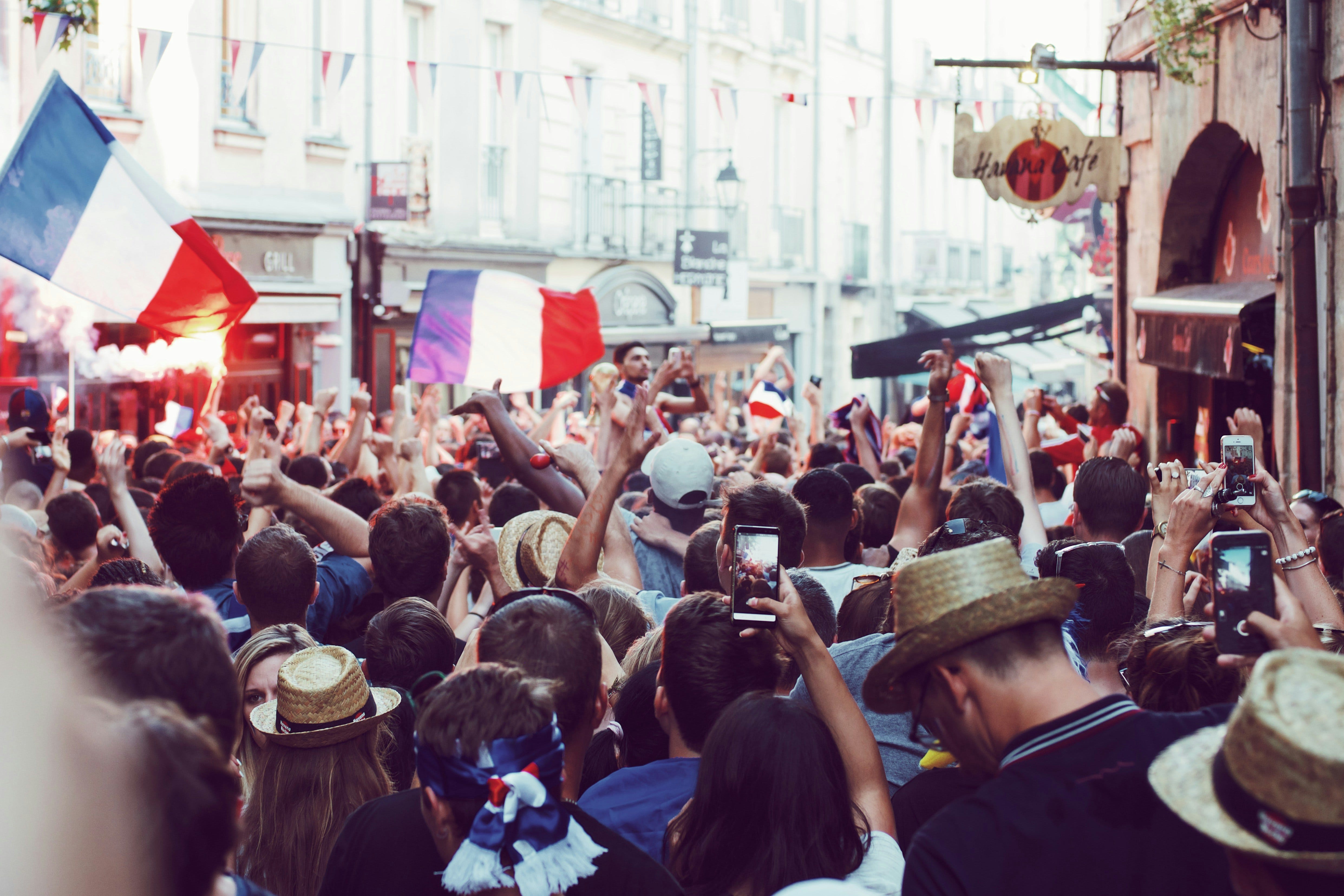
It was a summer evening in July 1998. I was at a scout camp in the Jura mountains, which meant I had spent most of the previous month completely disconnected from what was happening in France — namely, the World Cup (la Coupe du Monde), which France was hosting for the first time and which had the entire country in a state of collective delirium.
I had missed almost everything. The games (les matchs), the goals (les buts), the drama. Then, on the evening of July 12th, somebody organized something extraordinary: hundreds of scouts gathered in a field in front of several giant screens to watch the final (la finale). France vs Brazil. La France contre le Brésil.
That was my first real football match. Not in a stadium — in a field. With strangers, in the dark, surrounded by people who cared enormously, giving the context. France won 3–0. I became, overnight, what the French call a footix.
A footix is someone who only shows up to care about football when France is winning — a fair-weather fan, a bandwagon jumper. The term was coined mockingly during that exact 1998 World Cup, when suddenly millions of French people who had never watched a match in their lives were declaring themselves lifelong supporters. I was one of them. I am not ashamed. I was 11. It’s fine.
Why the World Cup is a French lesson in disguise
The World Cup does something strange. Every four years, people who haven’t thought about le football in months suddenly become experts.
Predictions appear, arguments start, group chats become tactical analysis forums — and if you’re learning French, you quickly discover another problem.
You need to talk about countries. Lots of countries.
L’Argentine. Le Brésil. Le Mexique. Les États-Unis.
You need to talk about players.
Un joueur australien. Une joueuse espagnole. Un gardien anglais.
You need to talk about :
Les matchs, les buts, les équipes nationales.
And that’s when French starts making things complicated.
Because nationalities (les nationalités) change depending on gender. And countries (les pays) have genders too. And unlike football, the rules aren’t always obvious.
Nationalities in French
When you describe a player by their nationality, the adjective changes depending on whether you’re talking about a man or a woman.
A Brazilian male player → un joueur brésilien
A Brazilian female player → une joueuse brésilienne
The Brazilian team → l’équipe brésilienne
Most nationalities simply add an -e in the feminine form. After a few matches, it becomes surprisingly natural.
Countries have genders — and it changes everything
The real challenge comes with the countries themselves.
Every country in French has a gender. This isn’t a minor detail. It determines which preposition you use — and getting it wrong sounds immediately off to any French speaker.
The basic system:
Feminine countries → en (en France, en Espagne, en Allemagne)
Masculine countries → au (au Brésil, au Canada, au Japon)
Plural countries → aux (aux États-Unis, aux Pays-Bas)
Here’s a first look at how it works in practice:
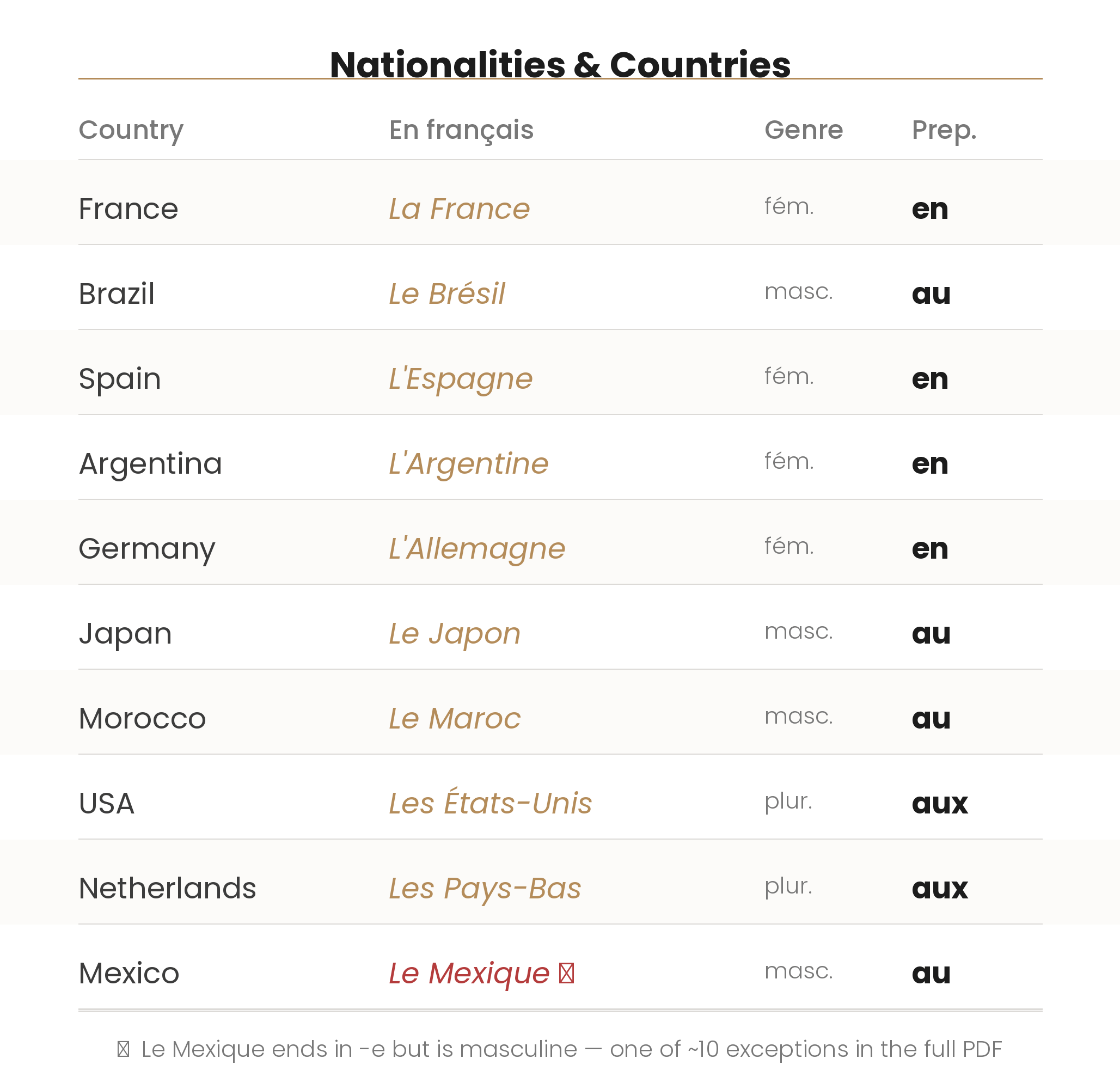
The pattern is clean — feminine countries end in -e, masculine countries generally don’t.
Except French wouldn’t be French without exceptions.
Le Mexique ends in -e and is masculine. Le Cambodge too. Le Zimbabwe too. There are about half a dozen countries like this.
Knowing them cold is the difference between hesitating mid-sentence and just talking — confidently, fluently, without doing mental grammar gymnastics while everyone else has moved on.
They’re all in the PDF, alongside 50+ nationalities, the full en / au / aux system with every exception explained and a vocabulary sheet for watching matches in French. Find the PDF in the Paid Subscriber Chat:

A few phrases to use this summer
Try these out loud. You’ll sound better than you think.
Tu regardes le match ce soir ? — Are you watching the game tonight?
La France joue contre l’Argentine. — France plays against Argentina.
Quel but ! — What a goal!
C’est quoi ton prono ? — What’s your prediction?
Je le sens bien ce match ! — I’ve got a good feeling about this one.
On va les bouffer ! — We’re going to destroy them.
Literally: we’re going to eat them alive.
Mbappé va faire un match de ouf ! — Mbappé is going to have an incredible game.
De ouf is verlan — French backslang — for fou, meaning crazy or insane. The highest compliment. Its evil twin: un match de merde, which explains itself.
Allez les Bleus ! — Come on France!
Les Bleus — the Blues — is the nickname of the French national team, after the color of their jersey.
One last thing
Before the next match, ask yourself: do you know how to say in Netherlands? In Haiti? In Qatar? If you hesitated on any of those — that’s exactly what the PDF is for.
The 2026 World Cup runs through mid-July. 104 matches, 48 teams, spread across the US, Canada, and Mexico. Pick a team. Learn one player’s name. Try saying quel match! when something incredible happens.
And if you find yourself in a bar with other French people, all of you suddenly very interested in football, all of you cheering for les Bleus with a passion you can’t quite explain — congratulations. You’re a footix now.
Welcome to the club. It’s a good one.
Timo

Je suis plutôt un footix… ou un cricketix, Timo ! Je regarde les matchs quand l'Inde domine ses rivaux. Maintenant, j'ai deux choix. Les chances que l'Inde se qualifie pour la Coupe du monde sont presque nulles. Donc, je supporterai le Canada — mon futur pays. Leur performance a été stupéfiante !
Allez les Bleus !