


Reading is not enough to speak fluently
Here’s what I’ve learned after years of teaching French: fluency comes from regular speaking practice, not from waiting until you feel “ready.”
Because that moment never really comes.
That’s why I created Le Cercle: a guided conversation space in small groups, designed for those who want to practice their spoken French consistently, build confidence, and see their progress become real. (see more info at the end of the article)
What I’ve learned about language learning
Speaking French can feel uncomfortable at first. I see it every week in my groups.
That little voice saying “not now,” “not yet,” “when I’m better.”
But here’s what I know now: the more you speak, the more natural it becomes. It’s that simple.
Reading and listening build your understanding. But speaking is what transforms that understanding into real fluency.
Waiting to feel “ready” almost never works. Confidence comes after you start speaking, never before. Every conversation, even a brief one, is a step forward.
Start small: speak from day one
You don’t need to be fluent to start speaking. You need to start speaking to become fluent.
That’s one of the first things I tell my students.
Introduce yourself. Use simple phrases like Comment ça va? or Comment tu t’appelles? Focus on communication, not perfection.
Even a few words spoken out loud activate the most important skill: producing the language. When this becomes regular, progress becomes visible and motivating.
I’ve seen it with hundreds of learners. The breakthrough never comes from grammar lessons. It comes from that first phrase you dare to say out loud.
Simplicity builds confidence
Many learners try to sound advanced too early. I understand why. But simplicity is far more effective.
In my groups, I always encourage learners to use short, clear sentences. Un café, s’il vous plaît (rather than Je voudrais un café, s’il vous plaît) is more than enough.
Confidence doesn’t come from complexity. It comes from using familiar structures until they feel natural.
One of my students told me recently: “I stopped trying to impress. Now I communicate. And it’s so much easier.”
And of course, put your ego aside and give yourself permission to be imperfect. You’re learning a foreign language. Mistakes are normal. Hesitation is normal.
Consistency beats intensity
Speaking once in a while feels difficult every time. Speaking regularly becomes normal.
A simple goal — a short conversation every week — is often enough to create real change. Each session reinforces what you already know and proves to you that you can speak.
One of my students, Audrey (check her substack here), who has just arrived in Paris shared something simple but very effective: she uses her dog as a reason to start conversations. A few words in the street, a short exchange in the park — nothing long, nothing impressive. But it happens often. And that’s the key. Short conversations, repeated regularly, change everything.
A helpful habit: Use a language journal to record your speaking milestones. Write down what you’ve learned each week and track how you’re improving. This will help you stay motivated and see your progress over time.
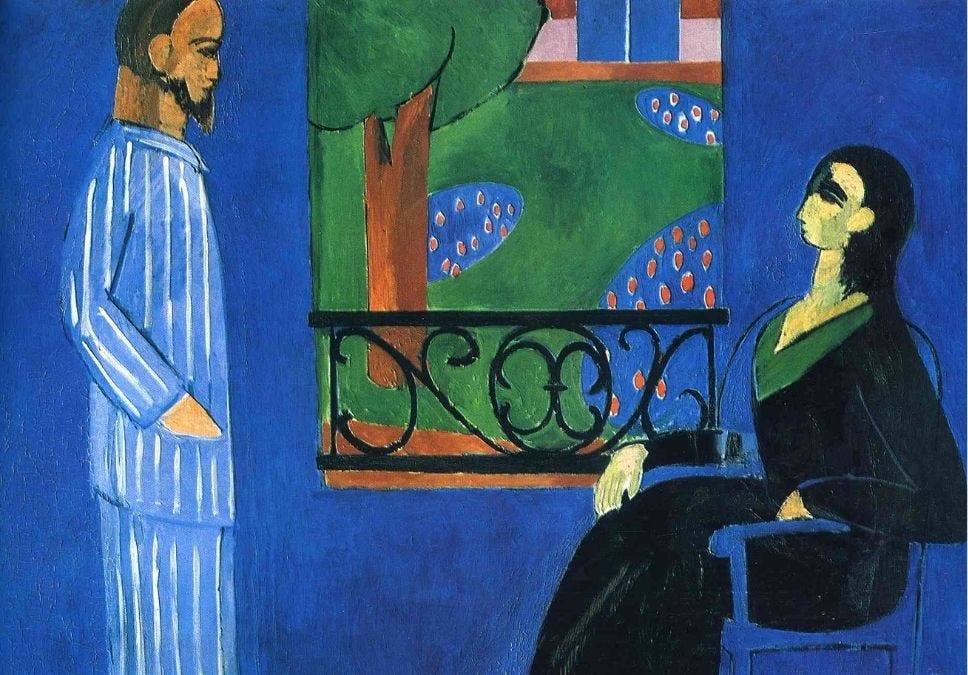
La Conversation, par Henri Matisse, 1909.
The right environment makes all the difference
Speaking anxiety usually comes from pressure, not from lack of ability.
That’s why environment matters so much. Small groups, clear structure, supportive atmosphere: all of this makes speaking easier — and makes you want to keep going.
When the environment feels safe, progress accelerates naturally.
A helpful habit: Use language exchange apps like Tandem or Speaky, where you can find learners at your level and practice speaking in a more relaxed environment.
What my students tell me most often
Most learners don’t lack grammar. They lack a space to use what they already know.
What I hear most often:
“I understand, but I freeze when I speak.”
“I know what to say, but I hesitate.”
“I just need a space where I can speak regularly, without pressure.”
What changes everything isn’t more studying, it’s speaking every week, in a calm, guided environment.
Speak at your own pace
Fluency isn’t about speed. It’s about ease.
Pause if needed. Think. Breathe. As confidence grows, speed follows naturally.
Like walking: you don’t rush. You walk regularly and one day, it feels effortless.
A helpful habit: If you’re nervous about speaking quickly, practice saying the same sentence several times, gradually speeding up until it feels natural.
Ready to take the next step?
Reading and listening build understanding. But speaking regularly is what transforms your French.
That’s exactly what Le Cercle is designed for:
weekly guided conversations in small groups, built to help you gain confidence, fluency, and consistency over time with modern tools to track recurring mistakes and areas for improvement, and personal feedback after each session.

How to join Le Cercle
Everyone participates in the same conversation groups
Minimum level: A2+ (lower intermediate).
You simply choose how often you want to join:
Option 1 — Le Cercle subscription (best value)
Upgrade your Substack subscription to receive:
1 year of weekly access to Le Cercle
A reduced price per session — 750 USD instead of
920 USDwhen you join before the end of January (15 USD approx per session)Full access to all premium content
Option 2 — Join from time to time
Book a single Le Cercle conversation session (19 USD each session)
Same group, same format — no commitment.
If you’re not sure which option is right for you, or if you simply want advice on how to improve your speaking, you can also book a free call with me.
No pressure. Just clarity and a clear path to better spoken French.
À vendredi pour un nouveau podcast !
Timothée

Merci pour le partage de mon Substack et pour ton super tutorat ! 🫶😊
At school we learnt conversational French in a language lab. We would record our own voices on tape and play it back. There is nothing so off putting as hearing yourself. Not recommended. Most French people are happy when you try to communicate in their language.