

Salut tout le monde !
This weekend, I had a bit of free time, so I treated myself to a delicious matcha latte and finally tackled a project I had been putting off for a while: creating visual resources to master the use of auxiliary verbs in compound tenses.
Why this topic?
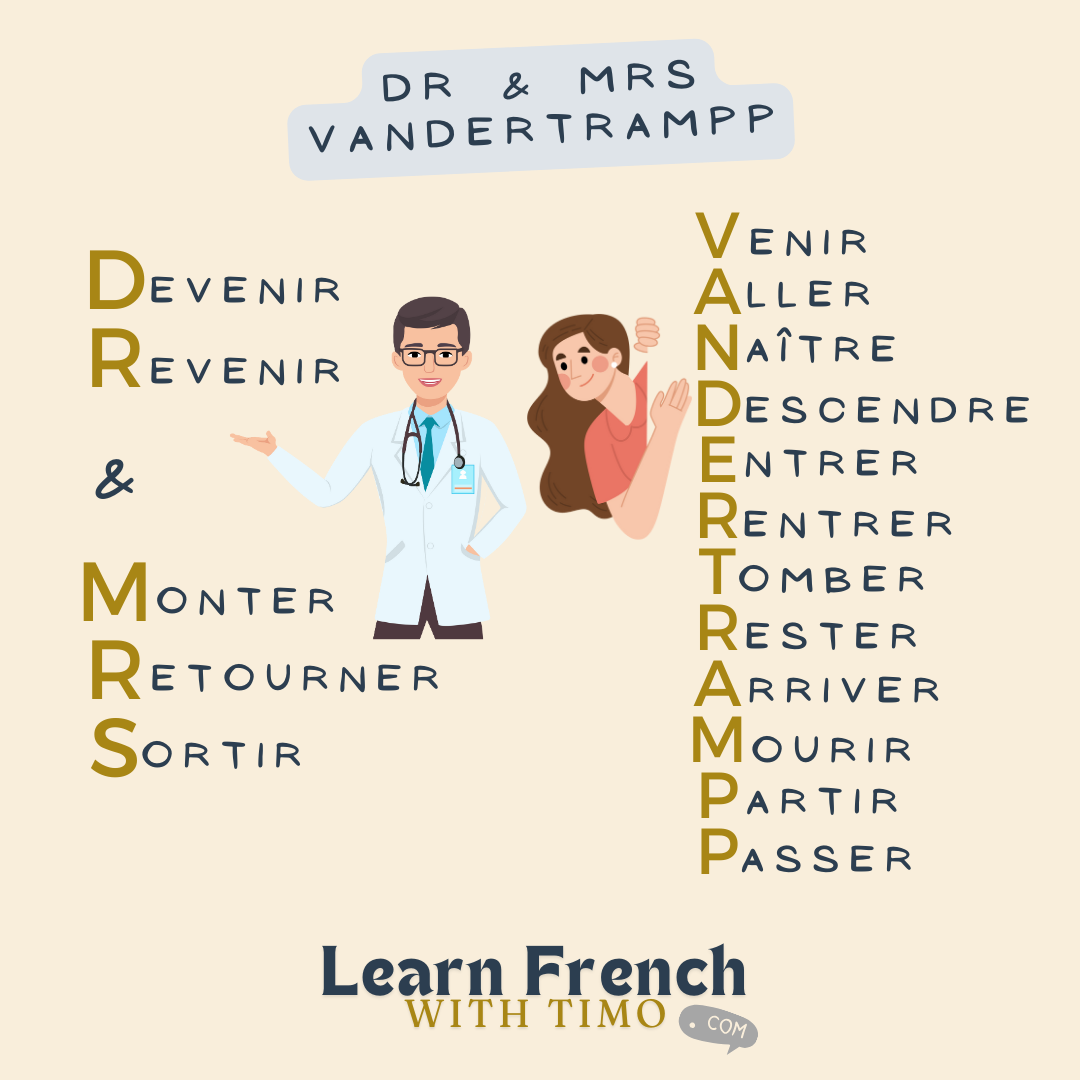
The most common mistake my students make is mixing up the auxiliaries “être” and “avoir” when using the passé composé. To address this, I revisited two well-known mnemonic tools: Dr & Mrs Vandertrampp and the Maison d’être.
Dr & Mrs Vandertrampp
This first tool involves memorizing a list of verbs through this famous “family name.” All these verbs are conjugated with the auxiliary être. For example:
Elle est devenue docteur.
Il est né à Madrid.
The Maison d’être
Personally, I prefer the Maison d’être because I find it more visual. However, the two tools are complementary, as the lists are not identical.
You can find these two visuals in the blog article—it’s my gift to you! Keep in mind, though, that these lists are not exhaustive. There are other verbs and special cases to know:
Verbs with the prefix “re-”
If you add the prefix “re-” to verbs from the previous lists, these verbs are also conjugated with être: repasser, retomber, revenir, etc. (But beware: not all these verbs accept the prefix “re-.”)
Some variants of “venir” (but not all)
Verbs such as devenir, parvenir, intervenir, provenir, and survenir are also conjugated with être.
Pronominal verbs
All pronominal verbs, formed with se, are conjugated with être. Easy!
Watch out for exceptions!
Verbs like descendre, (r)entrer, (re)monter, retourner, *passer and sortir are conjugated with avoir when followed by a direct object (COD). This generally changes their meaning:
Je suis rentré dans la maison.
J’ai rentré la voiture. (La voiture is a COD, so the auxiliary avoir is used.)
To make things easier, I’ve added a complete, detailed list in a downloadable worksheet available with premium access. You’ll also find a list of exercises with answers to practice.
I hope you’ll enjoy these resources! If you do, leave a comment—your feedback is always greatly appreciated. See you soon!

📚 Télécharge la fiche ci-dessous avec les visuels et les exercices pour pratiquer le choix de l’auxiliaire dans les temps composés (accès premium uniquement) :
➡️ 💾 Fichier PDF : 🔒 Become a paid subscriber to get access to the files.