


There’s one part of French that shows up in almost every conversation, and most learners never get it right: pronominal verbs (les verbes pronominaux).
❌ Je réveille à 7 heures. ✅ Je me réveille à 7 heures.
❌ J’habille. ✅ Je m’habille.
These aren’t ordinary verbs with “se” added on top — often the pronominal form is the only correct one. Leave it out and a native speaker won’t just correct you, they’ll need a moment to understand you. And if they speak English, they’ll probably just switch to it.
I put together the 50 pronominal verbs you’ll actually hear every day, with an example sentence, an English translation, and audio for each. There’s also a complete guide with the grammar and exercises if you want to go further.
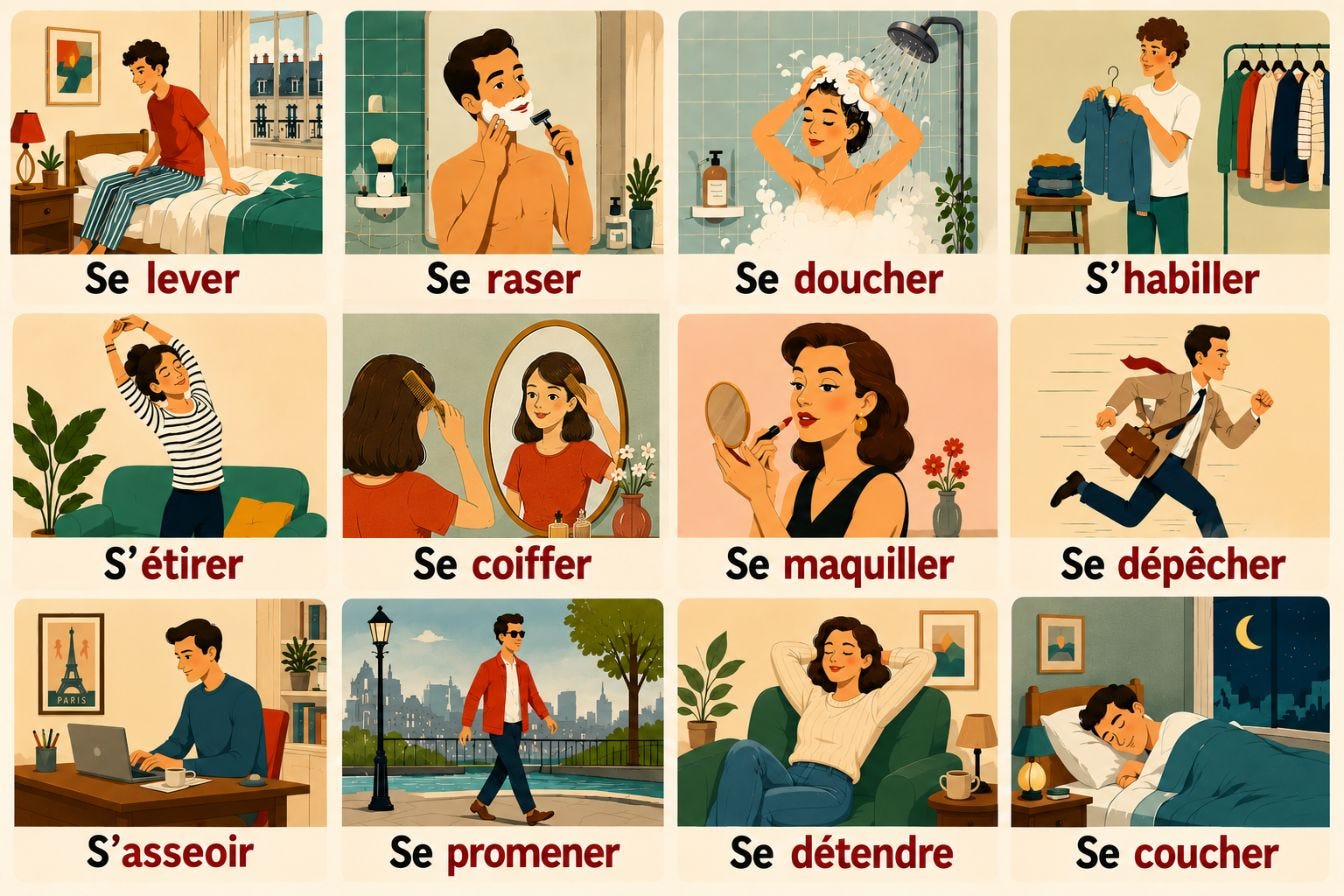
Here’s the full list, free:
Routine et vie quotidienne
S’appeler – to be called – Je m’appelle Paul.
Se lever – to get up – Il se lève à 7h.
Se coucher – to go to bed – Nous nous couchons tard.
Se réveiller – to wake up – Elle se réveille tôt.
S’endormir – to fall asleep – Le bébé s’endort vite.
S’habiller – to get dressed – Je m’habille rapidement.
Se déshabiller – to undress – Il se déshabille avant de dormir.
Se laver – to wash (oneself) – Elle se lave les mains.
Se brosser – to brush (teeth, hair) – Ils se brossent les dents.
Se maquiller – to put on makeup – Elle se maquille pour sortir.
Those are the easy, everyday ones. The next 40 are where it gets interesting: verbs like se débrouiller (to manage, get by), se douter (to suspect), se fier (to trust, rely on). The ones that don’t show up in a beginner textbook but come up constantly once you’re actually talking to people.
Actions, mouvements et habitudes
S’asseoir – to sit down – Asseyez-vous, je vous en prie.
Se lever (d’une chaise) – to stand up – Il s’est levé brusquement.
S’allonger – to lie down – Je m’allonge sur le canapé.
S’arrêter – to stop – Le bus s’arrête ici.
Se promener – to take a walk – Ils se promènent au parc.
Se balader – to stroll – On se balade en ville.
Se dépêcher – to hurry – Dépêche-toi, on est en retard.
Se calmer – to calm down – Il se calme après avoir crié.
Se reposer – to rest – Je me repose un peu.
S’entraîner – to train/practice – Elle s’entraîne tous les jours.
Communication et émotions
Se taire – to be quiet – Tais-toi, s’il te plaît.
Se fâcher – to get angry – Ils se fâchent pour rien.
S’énerver – to get annoyed – Je m’énerve facilement.
Se disputer – to argue – Ils se disputent souvent.
Se réconcilier – to reconcile – Ils se réconcilient rapidement.
S’entendre (avec) – to get along (with) – Je m’entends bien avec toi.
Se moquer (de) – to make fun (of) – Il se moque de moi.
Se plaindre (de) – to complain (about) – Elle se plaint du bruit.
Se confier (à) – to confide (in) – Je me confie à ma meilleure amie.
Se vouvoyer / se tutoyer – to address with vous/tu – On se tutoie ?
Mémoire, erreurs et compréhension
Se souvenir (de) – to remember – Tu te souviens de ce voyage ?
Se rappeler – to recall – Je me rappelle ton prénom.
Se rendre compte (de) – to realize – Je me rends compte de mon erreur.
S’apercevoir (de) – to notice – Je me suis aperçu de son absence.
Se tromper (de) – to make a mistake (about) – Je me suis trompé de bus.
Se méfier (de) – to be wary (of) – Je me méfie de lui.
S’imaginer – to imagine – Je m’imagine déjà en vacances.
Se douter (de) – to suspect – Je me doute de sa réponse.
S’intéresser (à) – to be interested (in) – Je m’intéresse à l’histoire.
Se concentrer (sur) – to focus (on) – Elle se concentre sur son travail.
Mouvements, situations et autres
S’en aller – to go away / leave – Il s’en va à midi.
Se trouver – to be located – L’école se trouve au centre-ville.
Se sentir – to feel – Je me sens fatigué.
Se débrouiller – to manage / get by – Je me débrouille en espagnol.
S’habituer (à) – to get used (to) – Je m’habitue à la vie en France.
Se marier (avec) – to get married (to) – Elle s’est mariée avec Paul.
Se séparer (de) – to separate / break up – Ils se sont séparés.
Se fier (à) – to trust / rely (on) – Je me fie à mon intuition.
Se servir (de) – to use – Il se sert d’un dictionnaire.
Se passer (de) – to do without – Je ne peux pas me passer de café.
You now know all 50 verbs. But knowing them and mastering them isn’t the same thing: agreements, idiomatic uses, the reflexes you need to use them without thinking. That’s what’s in the complete guide.
🔒 Unlock the complete guide + exercises
Download below the companion guide as a bonus with agreement rules, idiomatic uses, and practice exercises to take you from A1 to C1.