


Jouer. You know this one. Or at least, you think you do.
The thing is, jouer shows up in a lot more situations than just games and sports: music, performance, bluffing, gambling… And then there’s the à / de question, which sounds minor until you get it wrong in front of a French person.
So let’s sort it out properly.
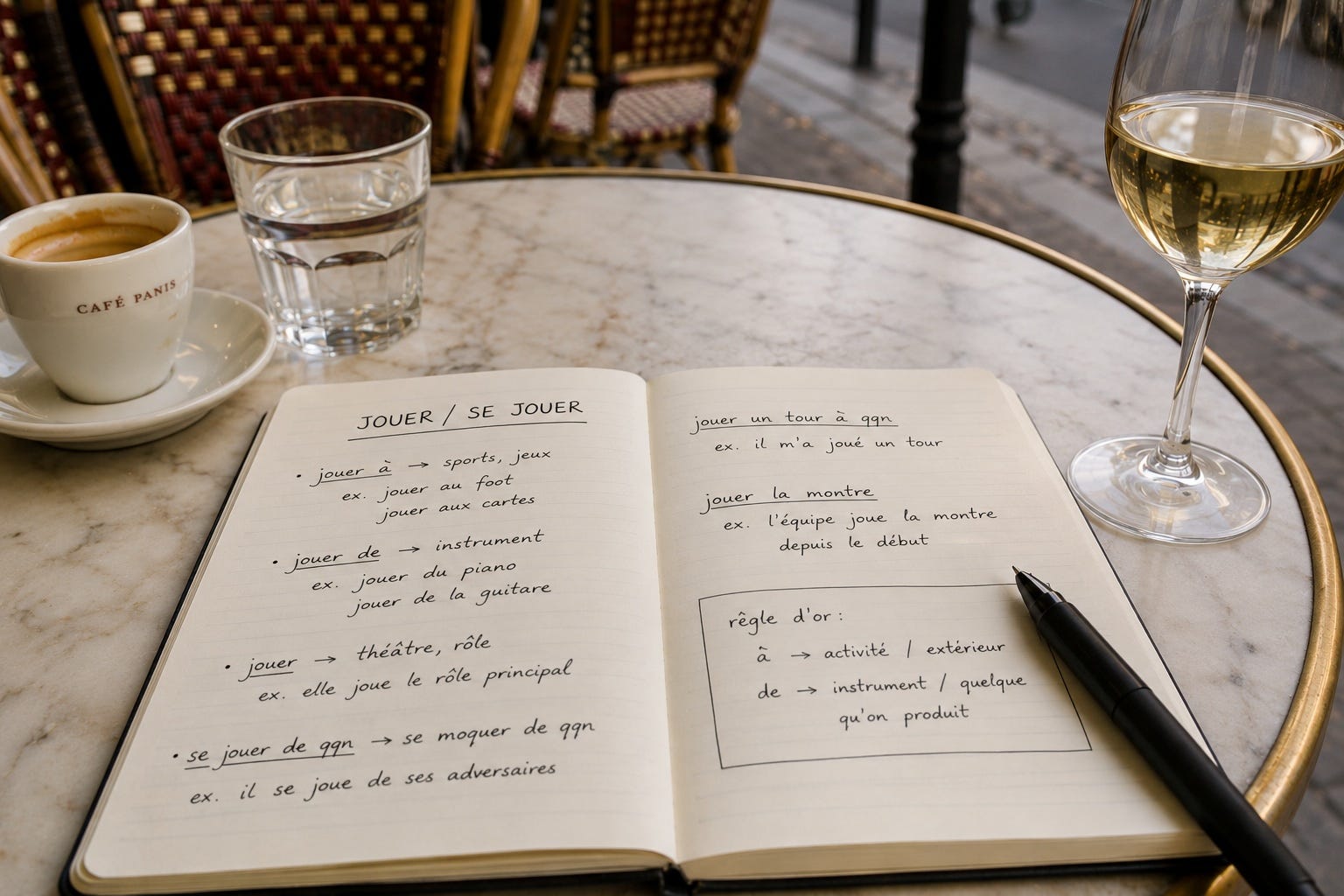
1. Jouer — to play (games, sports)
The most fundamental meaning. The one everyone learns first.
Les enfants jouent dans le jardin. → The children are playing in the garden.
On joue aux échecs ce soir ? → Shall we play chess tonight?
Elle joue bien, cette équipe. → That team plays well.
2. Jouer à / jouer de — the rule that changes everything ⚠️
This is THE distinctive feature of jouer that causes the most confusion. Here’s the rule:
Jouer à → for games and sports
⚠️ Contractions:
à + le = au
à + les = aux
jouer au foot, au tennis, aux cartes, aux échecs
Tu joues aux jeux vidéo ? → Do you play video games?
Elle a joué au volleyball toute sa jeunesse. → She played volleyball throughout her youth.
Jouer de → for musical instruments
⚠️ Contractions:
de + le = du
de + les = des
jouer du piano, de la guitare, du violon, de la flûte
Il joue de la batterie depuis l’âge de huit ans. → He’s been playing the drums since he was eight.
Tu joues d’un instrument ? → Do you play an instrument?
Memory trick: Think of the preposition as a question of contact. With a sport, you engage with an activity (à something out there). With an instrument, you draw something from it — a melody, a sound. De suggests extraction, production.
3. Jouer — to act (theatre and film)
Jouer is used constantly in the world of performance.
Elle joue le rôle de Juliette dans cette pièce. → She plays the role of Juliet in this play.
Qui joue dans ce film ? → Who’s in this film?
Il a joué dans plus de trente films. → He appeared in more than thirty films.
4. Jouer — to pretend, to feign
Playing a role… but not necessarily on stage.
Arrête de jouer l’innocent. → Stop playing innocent.
Il joue les victimes alors que c’est lui qui a tout déclenché. → He’s playing the victim when he’s the one who started everything.
Ne joue pas les surpris. → Don’t act surprised.
5. Jouer — to gamble
In the context of chance and money.
Il joue aux courses depuis vingt ans. → He’s been betting on the races for twenty years.
Elle a joué et perdu. → She gambled and lost.
Ne jouez pas avec votre argent. → Don’t gamble with your money.
6. Jouer un tour à quelqu’un — to play a trick on someone
A fixed expression well worth knowing.
Il m’a joué un tour. → He played a trick on me.
Ma mémoire me joue des tours. → My memory is playing tricks on me.
Ses nerfs lui ont joué un mauvais tour. → His nerves got the better of him.
7. Jouer sur — to play on, to exploit
Acting on something to produce an effect.
Elle joue sur les mots. → She plays on words / She’s splitting hairs.
Ce publicitaire joue sur nos émotions. → This advertiser plays on our emotions.
Il joue sur les deux tableaux. → He’s playing both sides.
SE JOUER
8. Se jouer — to be played / to take place
The pronominal form in its most factual sense.
Le match se joue demain à 21h. → The match is being played tomorrow at 9pm.
La pièce se joue au Théâtre de la Ville. → The play is on at the Théâtre de la Ville.
Tout s’est joué en quelques secondes. → It all happened in a matter of seconds.
9. Se jouer de quelqu’un — to toy with someone
A stronger meaning, with a shade of irony or superiority.
Elle se joue de ses adversaires avec élégance. → She toys with her opponents effortlessly.
Il s’est joué des règles toute sa vie. → He made a mockery of the rules his whole life.
10. Se jouer de quelque chose — to overcome with ease
A lovely expression conveying how effortlessly someone handles a difficulty.
Elle s’est jouée des obstacles comme si de rien n’était. → She brushed aside every obstacle as if it were nothing.
L’équipe s’est jouée de la défense adverse. → The team toyed with the opposing defence.
The auxiliary in compound tenses
Good news: jouer is a regular -er verb and always takes avoir in compound tenses, except in pronominal form.
J’ai joué → with avoir, in all non-pronominal cases
J’ai joué au tennis ce matin. → I played tennis this morning.
Je me suis joué de... → pronominal form, always with être
Elle s’est jouée de toutes les difficultés. → She effortlessly overcame every difficulty.
Il s’est joué de nous. → He made fools of us.
Idiomatic expressions
Jouer is fertile ground for vivid expressions.
Jouer le jeu — To respect the unspoken rules of a situation, to participate in good faith. Il faut jouer le jeu si tu veux être accepté dans l’équipe. → You have to play along if you want to be accepted in the team.
Jouer avec le feu — To take reckless risks. Tu joues avec le feu en lui mentant comme ça. → You’re playing with fire by lying to him like that.
Avoir le beau jeu — To have an easy, advantageous position. Il a beau jeu de critiquer maintenant que tout est terminé. → It’s easy for him to criticise now that it’s all over.
Jouer franc jeu — To act with honesty and transparency. Je vais jouer franc jeu avec toi. → I’m going to be straight with you.
Ne pas jouer dans la même cour — To not be at the same level. Ces deux équipes ne jouent pas dans la même cour. → These two teams aren’t in the same league.
C’est à toi de jouer — It’s your turn — literally and figuratively. C’est à toi de jouer ! → Your move! / It’s your turn!
Jouer la montre — To deliberately waste time, often at the end of a match. L’équipe d’Arsenal joue la montre depuis le début du match. → Arsenal have been playing for time since the start of the match.
Your turn! Write a sentence in the commentas using jouer or se jouer. And tell me: did you already know the jouer à / jouer de rule?
Et en bonus, un petit quiz pour pratiquer ce que vous venez d’apprendre : Quiz
