


Ma voisine Camille m’a raconté que sa belle-sœur avait vu le copain de Camille à la salle de sport avec quelqu’un d’autre.
My neighbor Camille told me that her sister-in-law had spotted Camille’s boyfriend at the gym with someone else.
So now Camille's convinced her boyfriend is cheating on her. Juicy, I know. But sadly, that's not why we're here. What we actually care about is how a good gossip session can affect grammar.
Two things run this system: le discours rapporté (reported speech) and la concordance des temps (tense agreement).
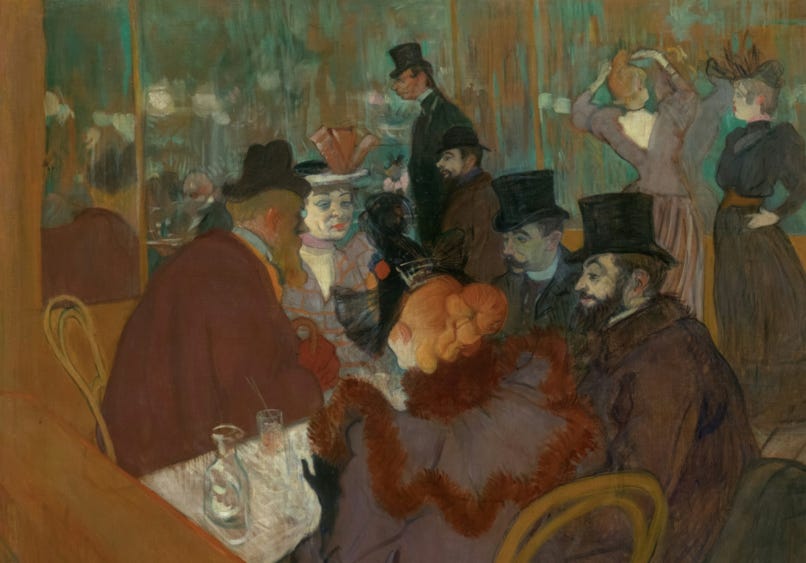
Au Moulin-Rouge, Henri de Toulouse-Lautrec
Le discours rapporté is how French speakers report what someone said: you either quote it word for word (discours direct), or you turn it into your own sentence (discours indirect).
La concordance des temps is the system that determines how verb tenses change when you report what someone said. The tense of the reported verb can change depending on the tense of the reporting verb.
One is about sentence structure. The other is about timing. You need both to gossip well in French.
1. Quoting someone vs. reporting what they said
Say Camille actually says this to you, word for word:
« Je crois que mon copain me trompe. » — “I think my boyfriend is cheating on me.”
If you repeat that exactly, quotation marks included, that’s discours direct. You’re basically a tape recorder.
But when you pass that on to someone else, you don’t quote Camille, you describe what she said, and her words have to be rebuilt from your point of view. For example, when a third person missed the gossip entirely and you have to let them know what happened:
Elle dit qu’elle croit que son copain la trompe. — "She says she thinks her boyfriend is cheating on her."
That’s le discours indirect, glued together with the word que (qu’ before a vowel).
Notice that the tense doesn’t change here: croit stays in the present tense because the introducing verb, dit, is also in the present tense. Nothing to shift backward. But the pronouns and possessives still change to match the new speaker: mon copain becomes son copain, me becomes la. You're not changing when the story happened, just whose mouth it's coming out of now.
2. Tense agreement, or why the story keeps changing tense on you
Once you attach someone’s words to a reporting verb in the past, like elle a dit que (“she said that…”), the original tense has to slide backward. We call it concordance des temps. Without it, you’ll be butchering your conjugation! Here’s what that looks like in practice.
Présent → Imparfait
Direct: Léa dit : « Je suis sûre qu’il la trompe avec sa collègue. »
Indirect: Léa a dit qu’elle était sûre qu’il la trompait avec sa collègue.
Passé composé → Plus-que-parfait