


Honest French, every week.
French with Timo is the newsletter that gets you past the plateau: from textbook French to the French people speak every day.
Open a conjugation guide and you’ll find more than 15 tenses, organized as if they were all equally important. In everyday life, you’ll hear some of them before you’ve even left the airport. But there are certain tenses you almost never use, even after 20 years of living in France.
One question that comes up again and again during my lessons is: How many of these do I really need? So today, I’m sharing this ranking with you, starting with the ones you’ll use every day and ending with the ones you’ll only use as a joke.
Tier 1: Every ten seconds
Le présent. Obviously. But it does more work than English speakers expect: je mange means both “I eat” and “I’m eating”. French does have a progressive form, je suis en train de manger, but people use it when they want to insist that they’re busy doing something right now. Most of the time, je mange does the job.
The present also covers the very near future. When a French person shouts « J’arrive ! » from the other room, they haven’t arrived. They’re on their way. Maybe.
I’ve got some bad news for you: this is the hardest tense of them all. Oui oui, we start learning French with the most difficult one! Être, avoir, aller and faire are all irregular, and you need them in your first hour. Think of it as a little test to see who’s really committed.
But here’s the good news: once you’ve got the hang of it, everything else will seem much easier!
Le passé composé. The everyday past. If something happened yesterday, last year or five minutes ago, this is the tense. In conversation it took over the job of the old passé simple a long time ago, and it gets shortened when people speak fast:
« T’as vu ? » (Did you see?) « J’ai pas fini. » (I haven’t finished.)
Tier 2: Every single day
L’imparfait. Descriptions, habits, how things were. If you only learn one sentence with it, make it this one: « C’était bien ? » (Was it good?) You’ll ask it and answer it after every film, every dinner and every holiday.
Le futur proche. Aller + infinitive, and you’re talking about the near future. « On va manger. » « Je vais l’appeler. » In casual conversation, you’ll hear it far more often than the futur simple.
L’impératif. Listen to a French family for ten minutes and you’ll hear a dozen: « Attends ! » « Regarde ! » « Arrête ! » « Vas-y ! »
Le conditionnel présent. The polite tense. « Je voudrais un café. » « Tu pourrais m’aider ? » « Ce serait sympa. » It softens everything, and French people use it constantly with strangers.
Le subjonctif présent. This one surprises my students. The subjunctive has a scary reputation, yet you’ll hear it every day, mostly with the structure il faut que: « Bon, il faut que j’y aille. » (Right, I have to go.) That’s how half of France ends a conversation.
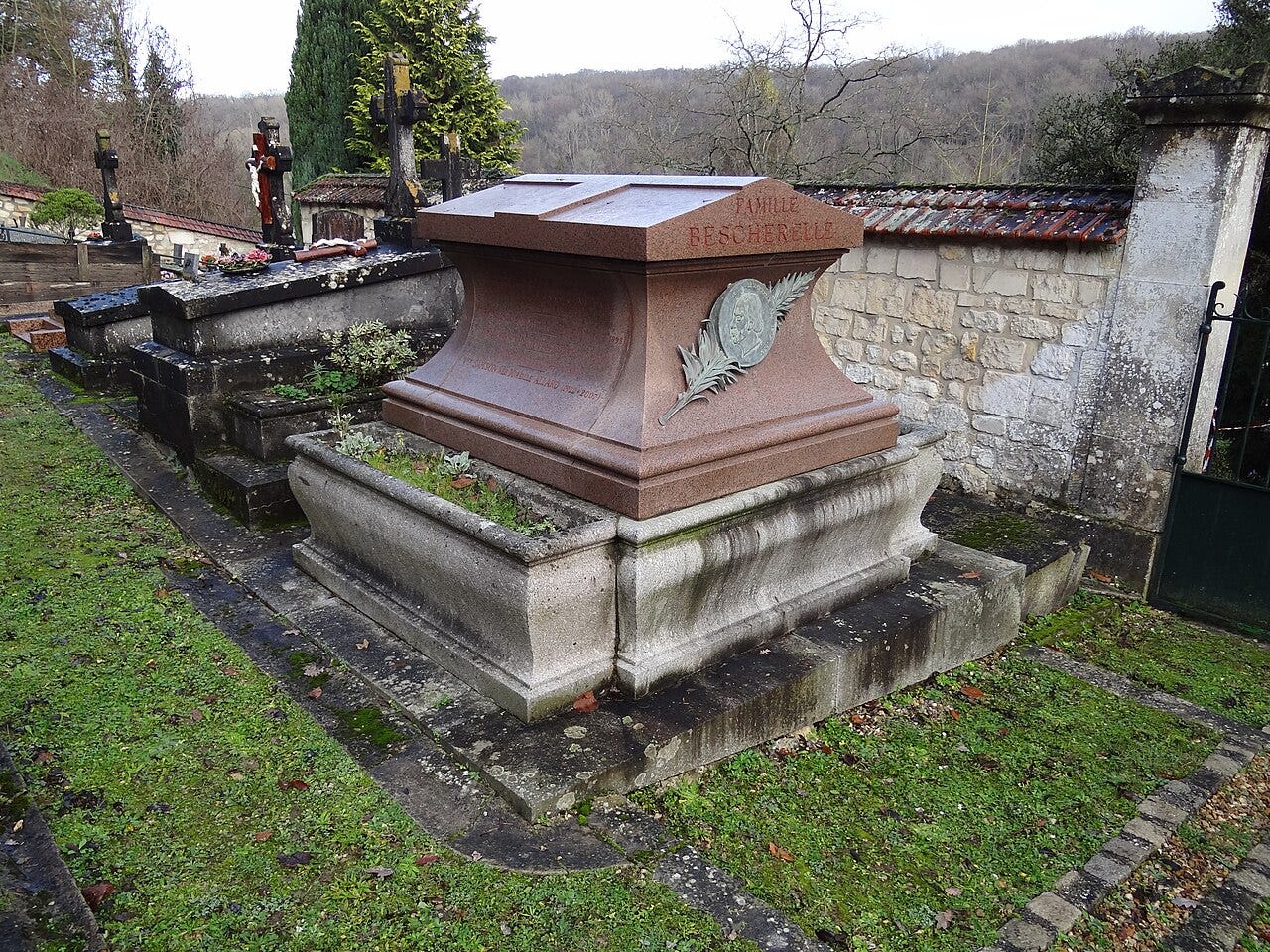
Every year, French learners make the trip to Valmondois, a little village north of Paris. They climb up to the cemetery and lie down on the grave of Louis-Nicolas Bescherelle (1802–1883), the man behind the famous conjugation book.
Legend says that after ten minutes there, the subjonctif finally makes sense.
Bon, ce n’est pas vrai… Mais ça ne coûte rien d’essayer, non ?
Tier 3: Several times a week
Le futur simple. It survives in conversation thanks to promises (« Je t’appellerai »), plans further away, and a few phrases everybody uses:
« On verra. » (We’ll see.) Often a polite way of saying no. « Ça ira. » (It’ll be fine.)
Le plus-que-parfait. The past before the past. « J’avais oublié ! » (I had forgotten!) And the most satisfying sentence in the French language: « Je te l’avais dit. » (I told you so.)
Le conditionnel passé. The tense of regrets. « J’aurais dû partir plus tôt. » (I should have left earlier.) « T’aurais pu me prévenir ! » (You could have warned me!)
Tier 4: Now and then
Le futur antérieur. “Will have done.” « J’aurai fini avant ce soir. » French people also use it to guess what happened: « Il aura encore raté son train. » (He’s probably missed his train again.)
Le subjonctif passé. « Je suis content que tu sois venu. » (I’m glad you came.) Useful, but it doesn’t come up every day.