


You can conjugate the subjunctive in your sleep… (do you?) Then two French people start chatting next to you, and half of what comes out of their mouths isn’t in any of your textbooks. Little words, slipped in here and there, that disappear before you even have time to figure out what they meant.
Taken on their own, they mean almost nothing, which is why no one bothers to teach them. But they’re very useful. They buy you time, soften a “no,” change the subject, and roll their eyes for you. Here are ten you’ll hear every day in France. Put them in your sentences and you will start to sound like a native.
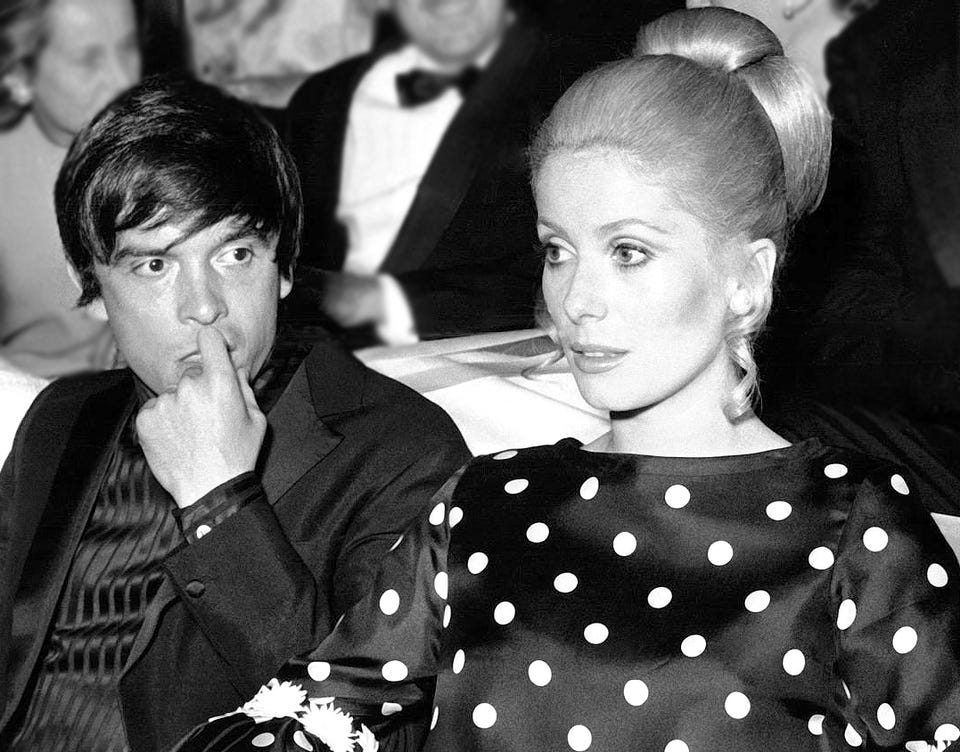
David Bailey wondering whether he’ll ever be able to speak French like Catherine Deneuve.
Les petits mots
1. Du coup
Links one idea to the next, or simply starts a sentence.
Du coup, on fait quoi ce soir ? (So, what are we doing tonight?)
It’s fine among friends, but it’s a bit much in a cover letter. Some French people are fed up with it, though that hasn’t stopped anyone.
2. En fait
Used to clarify, correct, or just get a sentence going.
En fait, c’est plus simple que ça. (Actually, it’s simpler than that.)
Keep it away from en effet, which means “indeed” and agrees with what was just said. En fait usually corrects it.
3. Genre
Approximates or softens what you say.
Il y avait genre cinquante personnes. (There were like fifty people.)
On its own with an eye-roll, Genre ! means “yeah, right”.
4. Bref
Long story short. Sums things up or moves the conversation on.
Bref, ça s’est bien passé. (Anyway, it went well.)
5. Bah
Often used when the answer feels obvious.
Bah oui. (Well, yes. Obviously.)
Careful with a long, sighed bah…, though. It sounds like you couldn’t care less.
6. Ben
Used to hesitate or start an answer.
Ben, je sais pas. (Well, I don’t know.)
Learn Eh ben ! too, the French “Well, well!”
7. Quoi
At the end of a sentence, it wraps up the idea. It isn’t a question, so the voice goes down.
C’était bien, quoi. (It was good, you know.)
The voice goes down. If it goes up, you’re asking “what?”
8. Voilà
Concludes an explanation or agrees with someone.
Voilà, c’est tout. (There you go, that’s all.)
You’ll hear it constantly once you start listening for it.
9. Enfin
Corrects or nuances what you just said.
Il est grand… enfin, plus grand que moi. (He’s tall… I mean, taller than me.)
Said sharply, Enfin ! means “Oh, come on!”
10. Carrément
As an answer, it’s an enthusiastic “totally”.
« Un apéro samedi ? »
— « Carrément ! »
In a sentence, it adds an element of surprise, often an indignant one.
Il m’a carrément raccroché au nez. (He actually hung up on me.)
Your homework this week
A four-minute clip from the film Mon inconnue (Hugo Gélin, 2019). Raphaël wakes up in a parallel world where Olivia, the love of his life, has never met him. In this clip, he decides to tell her the truth. If you’d like to watch the entire film, it appears to be available on France Channel.
Seven of the ten words above appear in the scene. Your task is to spot them.
Watch the scene once, focusing simply on the story. Pay attention to the expressions, the tone, and who is leading the conversation.
Watch it again and go on the hunt. Write down every single word you spot and the exact moment it appears. Bonus: there’s one little word I didn’t mention that keeps popping up in the conversation. Which one? The answer is in this week’s podcast.
Go back to the parts that went by too fast and replay them several times. It’ll become clearer than you think.
Pick a line you like and say it out loud along with the actors, at the same pace and with the same intonation, until you feel a little silly. That’s when it starts to sink in.
Bonus: Tell me in the comments which three words are missing.
Coming up
In the next podcast, Mon inconnue : les petits mots qui font la scène, we’re doing a special exercise. We watch the clip together, each on our own screen: you press play, I tell you when to pause. At each pause, I explain what they’re really saying, why it sounds so natural, and which words and expressions you can steal for your own conversations. There’s a quiz at the end. This podcast is for paid subscribers only.
Not a paid subscriber yet? You can upgrade your subscription here:
Bref, go do your homework.
Bonne semaine !
Timo
